FTI UMN and IEEE Women in Engineering Indonesia Section Forge Collaboration to Strengthen Women’s Roles in STEM
July 9, 2026
UMN and PT Surveyor Indonesia Invited to Share Collaborative Practices of Pesisir Berdaya Lestari at Exciting Banten Festival 2026
July 9, 2026Targeting Animal Welfare Issues, UMN MMT Students Optimize Adoption Campaigns with AI
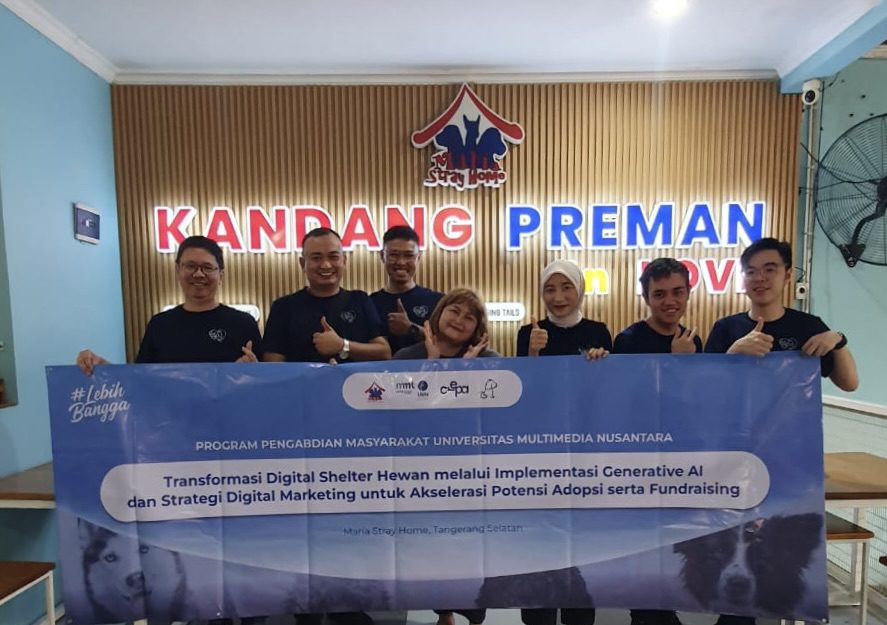
Tim Pengabdian kepada Masyarakat (PKM) Magister Manajemen Teknologi (MMT) UMN bersama pengelola Maria Stray Home dalam kegiatan penutupan program “Transformasi Digital Shelter Hewan melalui Implementasi Generative AI dan Strategi Digital Marketing untuk Akselerasi Potensi Adopsi serta Fundraising”. (dok. Daniel Aditya Kurniawan)
The Community Service (PKM) team from UMN’s Master of Technology Management (MMT) program, together with Maria Stray Home management, at the closing event of the program “Digital Transformation of Animal Shelters through Generative AI Implementation and Digital Marketing Strategies to Accelerate Adoption and Fundraising Potential.” (Doc. Daniel Aditya Kurniawan)
Community service does not always have to target issues that have conventionally been the focus of attention. Driven by this spirit, Master of Technology Management (Magister Manajemen Teknologi/MMT) students from Universitas Multimedia Nusantara (UMN) chose to provide solutions for Maria Stray Home, a stray dog shelter in North Serpong, South Tangerang. Through a digital marketing approach and the use of Artificial Intelligence (AI), the team aimed to help the shelter optimize its digital communication to reach potential adopters more effectively.
The selection of Maria Stray Home was not solely because of its proximity to UMN, but also because the team observed that there were still very few community service programs focusing on animal welfare. For them, this issue is connected to the Sustainable Development Goals (SDGs), particularly SDG 15 on Life on Land and SDG 17 on Partnerships. This collaboration brought together academics, the creative industry, and animal welfare advocates to address an issue that has not yet been widely approached through academic means.
During their observation, the team actually found conditions at the shelter that were far from their expectations. A clean, well-maintained environment and the presence of various pedigree dogs showed that the shelter was managed responsibly. However, behind these conditions, they still identified challenges in communicating the various good efforts that had been made to the wider public through digital media.
“Equally important, I see this as an issue relevant to the SDGs, particularly SDG 15 on Life on Land and SDG 17 on Partnerships. This collaboration brings together the academic community, the creative industry with shared concerns, and animal welfare advocates—something that rarely forms organically,” Daniel Aditya Kurniawan, a Batch 13 UMN MMT student and team representative, said.
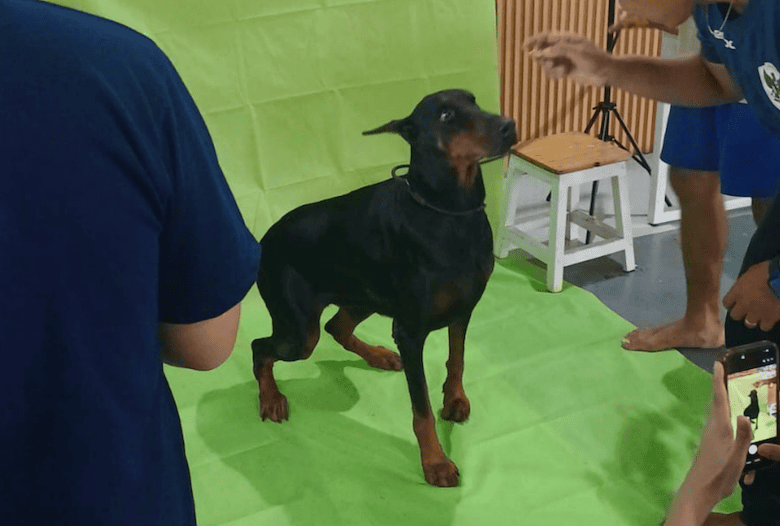
The UMN MMT Community Service team, together with Crepa Agency, conducted a photoshoot session with dogs at Maria Stray Home as part of creating visual assets for the digital adoption campaign. (Doc. Daniel Aditya Kurniawan)
The team then conducted an audit of Maria Stray Home’s Instagram channel before developing the program. From their observations, they found a lack of information about dogs ready for adoption, both in terms of visuals and narratives. After direct discussions with the shelter management, the team understood that all available resources were more focused on animal care, so digital content management had not yet become a priority.
This process was further reinforced when the team had the opportunity to meet Maria Stray Home at PetFest 2026. The challenge of processing seven dog photos using Generative AI within two days became the starting point of the collaboration. The successful completion of this challenge demonstrated that technology can serve as a practical solution to support the shelter’s digital communication needs without requiring high costs.
Building on the results of this analysis, the team not only focused on visual processing but also evaluated the communication strategies that had been used so far. They assessed that the adoption campaign approach needed to be packaged with more positive narratives to build public interest in animal adoption.
“From that, #LebihBangga (#MoreProud) was born. The idea is simple, but the shift is significant: adoption is not communicated as the opposite of buying dogs from breeders, but as an action that makes the owner proud—providing positive social incentives, not guilt. This aligns with the research by Rothman and Salovey that we used as our foundation—that positive framing has proven to be more effective in encouraging low-risk voluntary behavior compared to loss framing, which can actually trigger rejection. So, #LebihBangga is not just a campaign name, but a shift in perspective from ‘pity’ to ‘pride,'” Daniel explained.
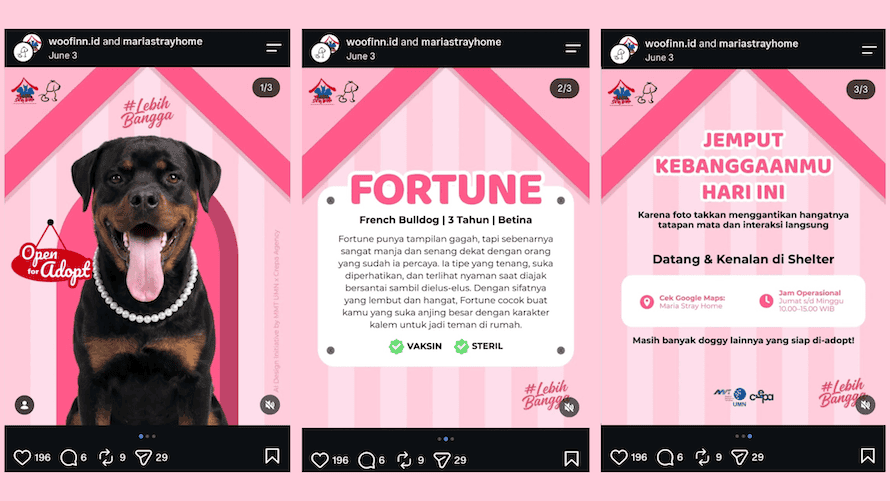
One of the outcomes of the UMN MMT PKM program implementation: Instagram content for the #LebihBangga adoption campaign designed to introduce dog profiles at Maria Stray Home to potential adopters. (Doc. Screenshot from Instagram/@mariastrayhome)
During the program, which ran from May to June 2026, the team successfully produced 34 Generative AI-based dog photo assets for Instagram Stories, including nine pieces of feed content. They also redesigned Instagram Highlights on donations, adoption requirements, and FAQs, while handing over Canva templates and video tutorials as part of knowledge transfer to enable the shelter management to develop content independently.
For the team, the success of this program was not only measured by the number of assets produced but also by the shift in perspective regarding the complexity of shelter management. The experience showed that resource limitations push non-profit organizations to seek solutions that are effective, efficient, and easy to implement in daily operations.
“What we are also grateful for is the increased technological literacy on the shelter’s side. If we look now at @mariastrayhome’s Instagram, there is already much more information designed with AI. In this project, we used Gemini AI for photo processing, then background removal, and Canva for content design—all for free. We hope that this foundation can be continued long after our program ends, because that is the true goal: not dependency on us, but their independence,” Daniel said.
On the other hand, this program also served as a form of implementation of the learning applied in UMN’s Master of Technology Management postgraduate program. Students are not only required to understand technology but also to be sensitive to social issues and able to translate theory into solutions relevant to community needs.
The PKM supervising lecturer, Dr. So Yohanes Jimmy, S.T., M.M., assessed that the essence of learning in the MMT program lies in concern for social issues. According to him, knowledge and skills become more meaningful when used to provide real benefits to the surrounding environment. Through this PKM, students were able to combine digital marketing and artificial intelligence competencies to strengthen Maria Stray Home’s communication, while also equipping the shelter management with the ability to operate various digital tools independently.
“At MMT, students are always taught to be sensitive to social problems or issues. They are encouraged to use their knowledge and skills to participate in responding to these issues. If they have knowledge but don’t care, then their knowledge is wasted. I think the essence lies in ‘caring,'” Jimmy explained.
Looking ahead, Jimmy hopes that this experience will not only benefit Maria Stray Home but also shape the character of students to remain sensitive to various issues in society. For the partner, Jimmy hopes that this collaboration marks the beginning of opening up space for discussion with higher education institutions as partners capable of providing solutions to various challenges they face.
This PKM program was carried out by a team of UMN Master of Technology Management (MMT) Batch 13 students consisting of Daniel Aditya Kurniawan, Cahya Munika, Adrian Raditya, and Nico Halisno under the guidance of UMN MMT lecturers Dr. So Yohanes Jimmy, S.T., M.M. and Assoc. Prof. Dr. Prio Utomo, S.T., MPC. In this PKM, Jimmy said the students were moved after seeing a dog shelter with a very noble mission. However, the achievement of the shelter’s mission was less than optimal, partly due to an unappealing presentation. The students then combined their expertise in digital marketing and artificial intelligence to overhaul the way the shelter communicates on digital channels.
By Melinda Chang | UMN News Service
English translation by Levina Chrestella Theodora
Kuliah di Jakarta untuk jurusan program studi Informatika| Sistem Informasi | Teknik Komputer | Teknik Elektro | Teknik Fisika | Akuntansi | Manajemen| Komunikasi Strategis | Jurnalistik | Desain Komunikasi Visual | Film dan Animasi | Arsitektur | D3 Perhotelan , di Universitas Multimedia Nusantara.