UMN Communications Faculty Conducts Guest Lecture with Kamidia Radisti, Reveals Public Speaking Strategy “From Fear to Clarity”
May 2, 2026
UMN Communications Lecturer Represents Indonesia in the IVPP Program at Parul University, India
May 2, 2026Learning Directly from The Industry, UMN Design Master’s Students Deepen Place-Making at M Bloc Space
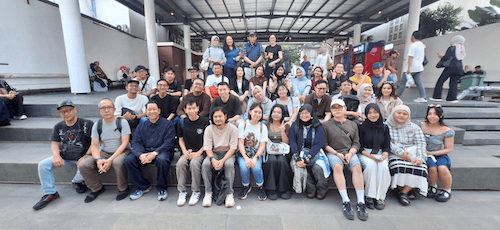
Mahasiswa Magister Desain Universitas Multimedia Nusantara bersama dosen pengampu mengabadikan momen kuliah lapangan di M Bloc Space, Jakarta Selatan, Sabtu (18/4/2026), sebagai bagian dari pembelajaran berbasis industri.
Master of Design students from Universitas Multimedia Nusantara, together with their lecturer, captured the moment of a field lecture at M Bloc Space in South Jakarta on Saturday (18/4/2026), as part of industry-based learning.
TANGERANG – That afternoon, the Blok M area was not merely a thoroughfare for young people looking for a place to hang out. Amid the rows of revitalized buildings, a group of Master of Design students from Universitas Multimedia Nusantara walked through and reinterpreted the meaning of a space at M Bloc Space, South Jakarta. For them, the visit on Saturday (18/4/2026) was not just a field lecture agenda, but an effort to understand how design truly lives within society.
This activity was part of the “Sustainable Regenerative Theory Double” course. The lecturer, Dr. Suwito Casande, S.Sn, M.Ds., saw the need for students to understand how regenerative concepts work in reality. He believed that theoretical approaches alone are insufficient to address the complexity of contemporary design, especially when students are required to respond simultaneously to social, cultural, and economic changes. In this context, M Bloc Space was chosen as a successful real-world example of how a space can be revitalized using an adaptive, sustainable approach.
More than just a creative space, M Bloc Space represents the concept of place-making, which is becoming increasingly relevant in the design industry. Through the theme “The Art of Place-Making: Multidisciplinary Collaboration Behind M Bloc Space,” students were invited to understand that design is no longer a standalone practice.
It grows from the convergence of various disciplines, from design and business to socio-culture, all intersecting to shape spatial experiences. In their field observations, students saw how a place is built not only physically but also through the narratives, activities, and communities that bring it to life.
“What we aim to achieve in this activity is essentially students’ understanding that design is not a single entity, but also that design is currently required to be adaptive by integrating not only design knowledge. It must also be able to involve other disciplines. That is why this course addresses the burden placed by the M.Ds. or Master of Design curriculum, especially regarding the interdisciplinary aspect,” Suwito explained.
The transformation of M Bloc Space itself served as a case study directly observed by UMN Design Master’s students. The former Peruri building, which had lost its function, has been revived into an active creative space capable of attracting various segments of society. Its impact has even extended to rejuvenating the Blok M area, which had previously experienced stagnation.
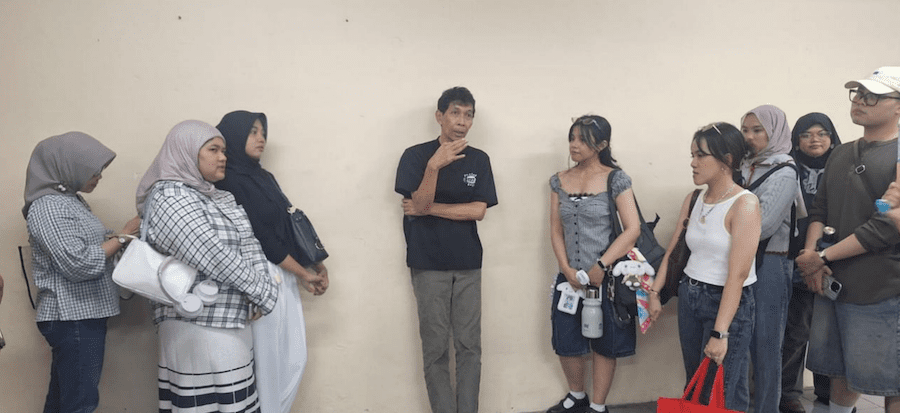
UMN Design Master’s students listen to a presentation an practitioner Handoko on sustainable concepts in the Blok M area.
According to Suwito, this field-based learning approach is ultimately an important strategy in Master of Design education, especially because most of its students are practitioners. He believes that understanding regenerative concepts would be difficult to achieve if relying solely on classroom theory rather than seeing them applied in real-world settings.
Students, he continued, do not only learn from the final outcome of a design but also understand the process, challenges, and complexity of decision-making behind it. This experience illustrates how a space must continuously adapt to user needs, from changes in visitor behavior to adjustments to more inclusive facilities.
“This field-based learning is actually a strategy to provide opportunities for students to learn directly from practitioners who have indeed implemented regenerative concepts, because these theories would be quite difficult to understand solely within classroom settings without examples of how regenerative concepts are applied in reality,” Suwito said.
From the students’ perspective, this experience provided new insights into how design works in reality. Steve Adrianto, a student from UMN Design Master’s Batch 1, observed that field learning offers a different dimension compared to classroom learning. He believes that relevant design is design that can read the changing times while understanding the continuously evolving market needs.
“The important lesson for me is that design must evolve with the times and observe market needs in the field,” Steve stated.
Furthermore, Steve also highlighted the shifting preferences of the younger generation in interpreting public spaces. According to him, fatigue with enclosed spaces, such as shopping malls, drives a need for more open, contextual spaces, like those offered by M Bloc Space.
“Young people are getting tired of healing places inside buildings, like malls; they prefer outdoor concepts,” Steve said.
Ultimately, this field lecture served not only as a learning tool but also as a space for students to reflect on the future role of design. They are no longer just learning to create forms; they are also understanding how design can be a tool to revive spaces, build identity, and respond to the ever-changing needs of society. In this context, design does not stop as a product but becomes a continuously adaptive process connecting the past, present needs, and future possibilities.
“This field lecture at M Bloc Space is able to impact students, namely by providing them with the skills to design circular urban design concepts that are clearly adaptive, innovative, and contextually appropriate. Furthermore, they are also able to become sensitive individuals who empower local capacity to solve societal problems using design knowledge,” Suwito concluded.
By Melinda Chang | UMN News Service
English translation by Levina Chrestella Theodora
Kuliah di Jakarta untuk jurusan program studi Informatika| Sistem Informasi | Teknik Komputer | Teknik Elektro | Teknik Fisika | Akuntansi | Manajemen| Komunikasi Strategis | Jurnalistik | Desain Komunikasi Visual | Film dan Animasi | Arsitektur | D3 Perhotelan , di Universitas Multimedia Nusantara.