UMN Communications Lecturer Represents Indonesia in the IVPP Program at Parul University, India
May 2, 2026
Promoting Inclusive Education, UMN and Universiti Malaya Launch the INCLUDE Student Mobility Program
May 12, 2026Collaboration Between UMN and Pradita University Breaks Through to National Victory Through a Post-Disaster Pavilion Design
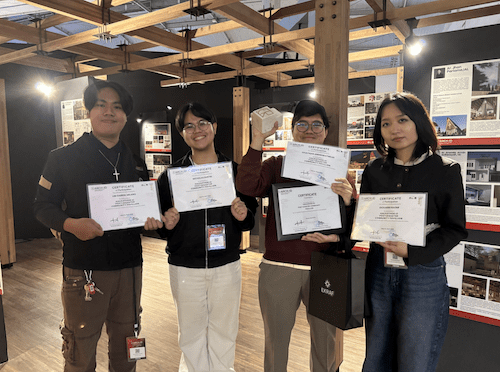
A joint team of Architecture students from UMN and Civil Engineering students from Pradita University pose with their award certificates after winning 3rd Place in the Hackathon #3 ARCH:ID 2026 competition at Indonesia Convention Exhibition on April 26, 2026.
A joint team of Architecture students from UMN and Civil Engineering students from Pradita University pose with their award certificates after winning 3rd Place in the Hackathon #3 ARCH:ID 2026 competition at Indonesia Convention Exhibition on April 26, 2026.
Tangerang – In just 6 hours, a group of students from different studies had to built a room, whereas it’s not just a lone place to standstill after disaster, but also restoring the lives of the people within it. Under time constraints in a Hackathon ARCH:ID 2026 competition, a collaborative group between Architecture Universitas Multimedia Nusantara (UMN) and Civil Engineering Study Program, Pradia University tries to interpret post-disaster conditions into designs that are quick to build, contextual, and still humane.
The team consist of Nicholas Dustin Dipraja (Architecture UMN 2024), Dzulfiqar Andrewiatmojo (Architecture UMN 2024), Giovanni Naomi (Architecture UMN 2024), serta Lim Gabriel Milano (Civil Engineering, Pradita University 2024) successfully secured the 3rd Place in the Hackathon #3 ARCH:ID 2026 competition held at Hall 8 ICE BSD City on 26th of April 2026.
“The main concept are Recovery, Resilience, and Humanity (Pulih, Tangguh, dan Humanis). We expected the pavilion design could be a new space for the society who got impacted by flood disasters,” said Nicholas Dustin Dipraja, the team representative.
Rather than providing a temporary evacuation shelter, the team tried to design a pavilion that would remain relevant even after the emergency period had ended. They recognized that post-disaster communities require not only physical protection, but also social spaces that can support the recovery of everyday life.
Because of that, the concept “Recovery, Resilience, and Humanity (Pulih, Tangguh, dan Humanis)”, are interpreted as a modular pavilion that can be built quickly and flexibly according to the community’s needs. Every module is designed with the measurement 6×12 meter and it can also be reconfigured into a smaller scale to make it more feasible in terms of both cost and construction time.
“The Pavilion is designed as a “Recovery” space for social recovery, “Resilience” in facing the condition post-disaster, and “Humanity” as placing the community’s needs at the center of the design. We started to create the design based on humans, so this concept is aligned with the capabilities of the local community so that it can realistically be built and serve as a pavilion that supports recovery,” explained Dustin.
The Pavilion design didn’t just function as emergency needs. The team also thought about how the building still serves daily life and is beneficial for the society in normal conditions. Open space on the pavilion is possible in that area to be used for activity, starting from kiosk to help the economic condition to a viewing stand for football matches, as the site is located near the community football field.
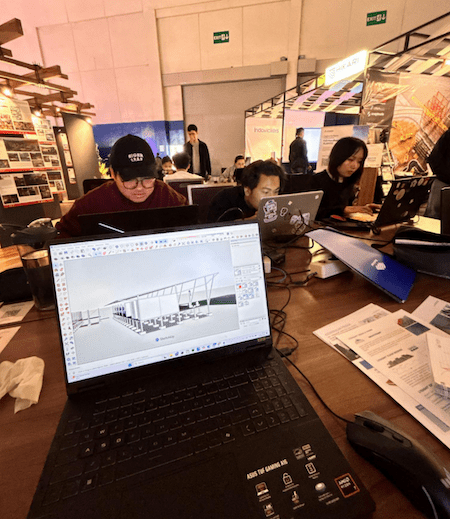
The UMN’s Architecture student team and Pradita University Civil Engineering student team during the design process of the Post-disaster Community Pavilion for the Hackathon #3 ARCH:ID 2026 competition at Indonesia Convention Exhibition.
This framework was shaped by the learning experiences they gained throughout their academic journey. Dustin explained that UMN’s architecture students are encouraged to design based on context and the real needs of the user, not just learning visual construction.
Beside considering the society needs, the team also thought about sustainability aspects from the building design. The pavilion is created as a permanent building so it won’t create any more waste after the emergency condition ends so the society could still use it for a long time.
For Dustin, this insight is influenced by the learning framework in UMN’s Architecture, which emphasizes contextual design and sustainability in every design process.
“On every design, we always get the awareness to design based on the context, we design based on what’s the needs. Even every design should be considering the sustainability value, so we design the pavilion as a permanent building and it won’t make any waste, and society could use it over and over again”, said Dustin.
Hackathon ARCH:ID 2026 competition carrying the theme ‘Skema Sintesa – Architecture of Engagement,’ which positions architectural practice as a form of cross-disciplinary and cross-scale collaboration. In six hours, all of the participants were challenged to produce design solutions that are innovative, systemically relevant, and feasible to fabricate. Amid the time pressure, the UMN’s student team had to compete against participants from various other universities.
“Thank God, we got 3rd place. It is something great to be achieved by 4th semester students in a design competition that needs to be done quickly. We were also able to keep up with and compete against the competencies of students from public universities, including those in their 6th and 8th semesters. Personally, achieving 3rd place in an architecture competition in Semarang within the same month was truly extraordinary and something I had never expected. As a student who had only recently begun exploring digital design, being able to compete with more experienced seniors was a remarkable experience,” stated Dustin.
This achievement also received appreciation from Hedista Rani Pranata, S.Ars., M.Ars., Head of the Architecture Study Program at UMN. For her, the UMN’s architecture curriculum is indeed designed with a sustainability framework and BIM technology, so the students are ready to face the industry challenges.
UMN’s students aren’t just learning about the aesthetic side, but also have the knowledge about environment, social, and an integrated digital workflow. The learning process is also directed toward problem-solving and real-world case studies, allowing students to become accustomed to the complexities of the professional world from an early stage
She saw the student’s achievement in the national competition as proof of the consistent quality and competitive spirit of UMN’s architecture student. Moreover, this achievement is also a reminder to always develop and dare to take on greater challenges.
“However, this achievement does not make us complacent. On the contrary, it serves as an additional motivation for us to continue improving the quality of education and encourage students to take on even greater challenges. We hope this accomplishment can also inspire and motivate younger students to become more confident in participating in competitions,” said Hedista.
For Dustin, the experience in joining the Hackathon competition strengthened his perspective on the role of architects within society. He saw that a great design wasn’t just about the visual look, but how a building could really answer the needs of the user.
“It is very much important to build something contextual and not just think about our own self to be popped out on the design. We always had to put priority on the building function first so the shape of the building could later on adjust. What is the point in creating something good but didn’t function optimally”, stated Dustin.
By Melinda Chang | UMN News Service
English Translation by Rachel Tiffany
Kuliah di Jakarta untuk jurusan program studi Informatika| Sistem Informasi | Teknik Komputer | Teknik Elektro | Teknik Fisika | Akuntansi | Manajemen| Komunikasi Strategis | Jurnalistik | Desain Komunikasi Visual | Film dan Animasi | Arsitektur | D3 Perhotelan , di Universitas Multimedia Nusantara.