Debut First Front Office Competition, UMN Hospitality Student Wins 1st Place at HOSPITOUR 2026
May 14, 2026
Promoting Inclusive Education, UMN and Universiti Malaya Launch the INCLUDE Student Mobility Program
May 12, 2026
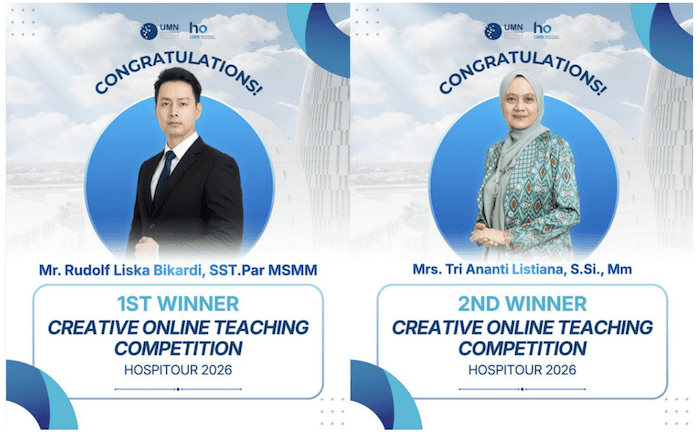
Lecturers from the Hospitality Program at Universitas Multimedia Nusantara (UMN) successfully won 1st and 2nd place in the “Creative Online Teaching Competition” category at HOSPITOUR 2026.
TANGERANG – The achievement of lecturers from the Hospitality Program at Universitas Multimedia Nusantara (UMN) at HOSPITOUR 2026, organized by Universitas Pelita Harapan, demonstrates how digital learning innovation continues to evolve amidst the changing global hospitality industry. In the “Creative Online Teaching Competition,” Rudolf Liska Bikardi, S.S.T.Par., M.S.M.M. secured first place, while Tri Ananti Listiana, S.Si., M.M. won second place after competing against 32 universities from across Indonesia. The winners were announced online on April 21, 2026, via Zoom, before an on-site ceremony was held on April 24, 2026.
Under the main theme of EVOLVE (Empowering Visionary Oriented Local and Virtual Experiences), the competition challenged participants to design creative, interactive online learning processes relevant to the current needs of the hospitality industry. Participants were required to create online teaching videos in accordance with specific technical guidelines.
In the competition, Rudolf Liska Bikardi developed a learning approach that combines digital technology with virtual experiences in the hospitality industry. The learning materials were designed not only to convey theory but also to encourage active student engagement in the learning process through interactive videos and case studies.
“I believe that hospitality education today must keep pace with technological developments to remain relevant,” Rudolf said.
This approach serves as a means of translating the theme of virtual experiences into an applied learning process. In his presented material, Rudolf created virtual industry experience simulations to help students better understand hospitality practices in context. According to him, hospitality education is no longer sufficient if it focuses only on conventional operations; it must also respond to developments in digital hospitality.
The creative teaching material he presented also highlighted various technological developments in the hospitality industry, ranging from virtual guest experiences and digital service innovation to the use of artificial intelligence in services and the importance of digital communication skills. These were designed to prepare students to face the technological disruption increasingly evident in the global industry.
“To address the global challenge of technological disruption in the hospitality industry, the creative teaching material I presented was designed so that students not only understand conventional hospitality operations but also grasp digital hospitality developments, such as virtual guest experiences, digital service innovation, the use of AI in services, and the importance of digital communication skills,” Rudolf explained.
Meanwhile, Tri Ananti Listiana interpreted the concept of “Visionary” through a learning module themed “Sustainable Hotel,” based on the “Principles of Management” course. According to her, the visionary concept is not only about future leadership but also about the ability to see the long-term impact of decisions made today.
In this module, students are invited to understand sustainability issues through a reflective and contextual approach. Before delving into theory, students are confronted with thought-provoking questions about the hotel industry’s impact on global warming and climate change. Illustrations of flooding, loss of tourists, and high hotel energy consumption are used to build student awareness of environmental challenges in the hospitality industry.
“With such questions and illustrations in the online module, students begin to think that hotels can also cause negative impacts in the future if not handled and managed with good sustainable principles,” Tri said.
Not only focusing on conceptual understanding, but the module is also designed to be applied through team-based collaborative assignments. Students are asked to create a hotel action plan that focuses on financial savings while implementing sustainable hotel principles. This approach is expected to create a virtual learning experience that still feels close, human, and effective.
The success of these two lecturers is inseparable from the support of various parties within UMN. Tri explained that the key elements in the success of their teaching materials include a structured teaching cycle, organized lesson plans, strong visual illustrations, clear subtitles, and technological support from UMN’s E-Learning Department.
“This is a team victory, not my victory alone,” Tri said with a warm smile.
On the other hand, Adestya Ayu Armielia, S.ST.M.Si.Par., Deputy Head of UMN’s Hotel Operations Department, explained that this achievement serves as external validation of the quality of the curriculum and learning innovations developed within UMN’s Hospitality Program. According to her, the curriculum was not explicitly designed for competitions. Still, the various competencies required by the industry and competitions have been integrated into the courses through CLOs and Sub-CLOs.
Furthermore, learning in UMN’s Hospitality Program also extensively applies project-based learning and competitive simulations that train both students and lecturers to handle pressure, build output quality, and generate learning innovations relevant to industry needs.
“I hope that achievements in competitions, both for lecturers and students, will continue to grow in the coming years. Additionally, I hope this achievement will impact industry confidence in choosing UMN Hospitality Program graduates for employment, and also reassure prospective students in choosing UMN’s Hospitality Program for further study,” Adestya said.
Moving forward, the creative teaching innovations developed in this competition are expected to be continuously applied in UMN’s Hospitality Program classrooms. Both Rudolf and Tri emphasized the importance of industry-based learning, collaborative learning, digital simulation, and sustainability to prepare students to face the global hospitality industry, which continues to evolve digitally and sustainably.
“Going forward, I want to integrate further industry-based learning, digital simulation, project-based learning, and collaborative learning so that students have learning experiences that are more relevant to the needs of the global hospitality industry, and actively engage in the learning process,” Rudolf stated.
By Melinda Chang | UMN News Service
English translation by Levina Chrestella Theodora
Kuliah di Jakarta untuk jurusan program studi Informatika| Sistem Informasi | Teknik Komputer | Teknik Elektro | Teknik Fisika | Akuntansi | Manajemen| Komunikasi Strategis | Jurnalistik | Desain Komunikasi Visual | Film dan Animasi | Arsitektur | D3 Perhotelan , di Universitas Multimedia Nusantara.