Opening Up Room for Collaboration, DPR’s BKSAP and UMN Discuss The Development of AI
October 8, 2026
Holding The 31st Commencement in Two Sessions, UMN Produces Adaptive, Future-Ready Graduates
October 8, 2026Interesting Content Isn’t Enough: UMN Rector Highlights “News We Can Use” in the Era of the News Creator
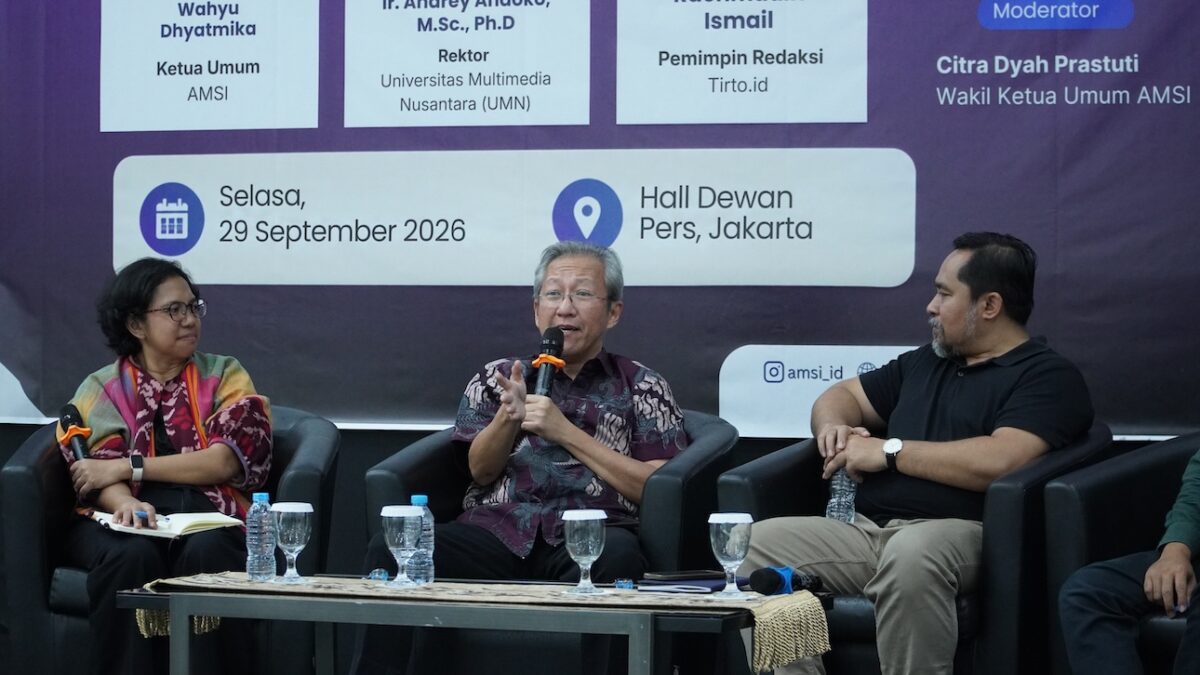
Rektor Universitas Multimedia Nusantara (UMN) Ir. Andrey Andoko, M.Sc., Ph.D. (di tengah) menyampaikan pandangannya dalam Diskusi Bulanan September 2026 bertajuk “News Creator sebagai Peluang Revenue Baru bagi Media” yang digelar AMSI bersama UMN di Hall Dewan Pers, Jakarta, Selasa (29/9/2026).
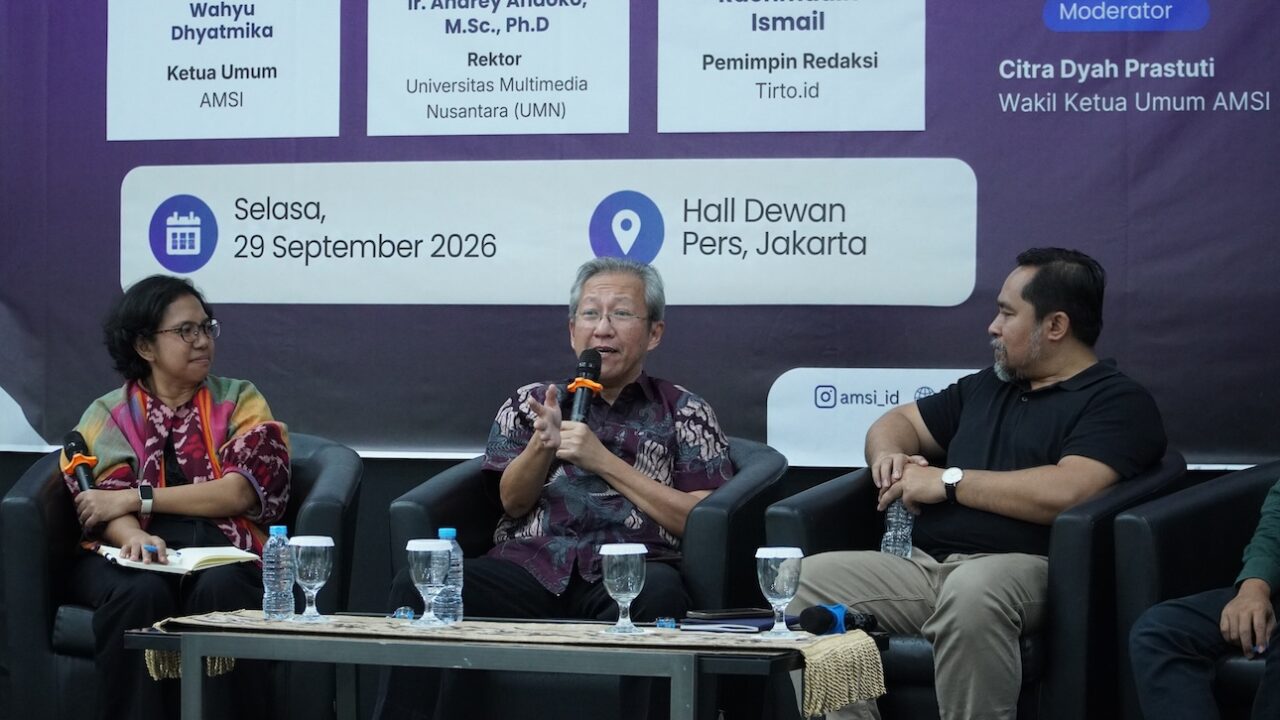
The Rector of Universitas Multimedia Nusantara (UMN), Ir. Andrey Andoko, M.Sc., Ph.D. (center), shares his views at the September 2026 Monthly Discussion titled “News Creators as a New Revenue Opportunity for Media,” held by AMSI together with UMN at the Press Council Hall, Jakarta, Tuesday (29/9/2026).
TANGERANG – Universitas Multimedia Nusantara (UMN), together with the Indonesian Cyber Media Association (AMSI), discussed the rise of news creators as an opportunity to develop new revenue for the media industry. At the September 2026 Monthly Discussion titled “News Creators as a New Revenue Opportunity for Media,” held at the Press Council Hall in Jakarta on Tuesday (29/9/2026), the academic perspective highlighted how changing patterns of information consumption are affecting the way media outlets produce and distribute content.
UMN Rector Ir. Andrey Andoko, M.Sc., Ph.D. argued that a creator’s success does not rest on appeal alone. Content also needs to deliver a benefit the audience can actually feel.
“Creator content succeeds because what’s presented isn’t only interesting, to my mind, but because I then feel the benefit of it,” Andrey said.
The discussion brought together industry and academic perspectives on the shifting digital media ecosystem. Besides Andrey, the event featured AMSI Chair Wahyu Dhyatmika and Tirto.id Editor-in-Chief Rachmadin Ismail. It was also attended by UMN students, members of the press, and civil society.
In his presentation, Wahyu highlighted how young people are changing the way they find news. Gen Z can now discover information through a wide range of content formats and platforms, so media outlets need to adapt how they deliver information to keep reaching their audience.
Wahyu sees the news creator as one response to that change. On social media, news creators can take on several roles, from clarifying information and keeping an issue warm to investigating something or acting as a commentator.
“The answer is the news creator: how to make sure mainstream media also has a strong social media presence,” Wahyu said.
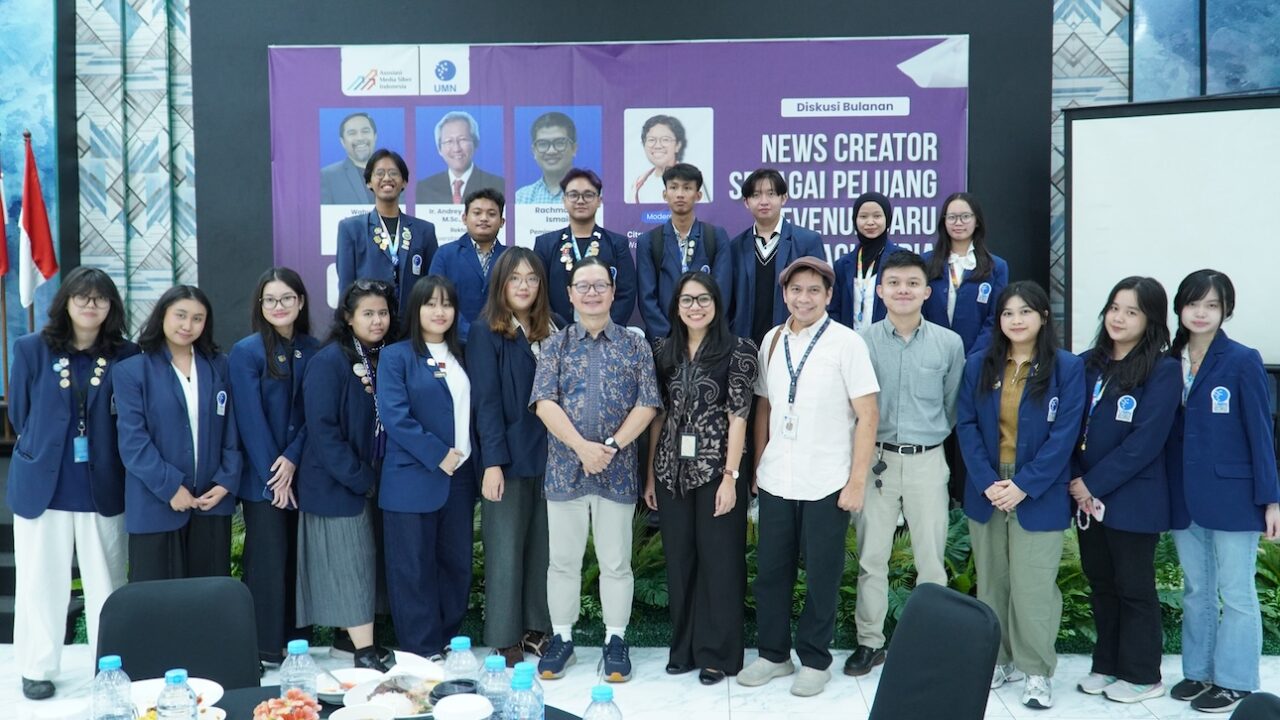
Academics and students from Universitas Multimedia Nusantara (UMN) attend the September 2026 Monthly Discussion titled “News Creators as a New Revenue Opportunity for Media” at the Press Council Hall, Jakarta, Tuesday (29/9/2026).
That shift in how audiences find the news also concerns UMN Rector Andrey. In his view, people today focus on the information they need, without always making the media source their main consideration.
“People look for the information they need regardless of where the source comes from,” Andrey said.
Andrey linked the phenomenon to the concept of “news we can use.” In his view, the public’s need for information that offers a benefit is not actually new in the development of journalism. The rise of social media has reinforced that concept by changing how information is distributed to the public.
As social media has grown stronger, audiences have also faced an ever-larger flow of information. With limited time, people don’t always actively seek out the news; instead, they may receive information based on what appears on the platforms they use.
These conditions mean that media outlets need to consider both quality and content distribution strategy. According to Andrey, content needs to be delivered in the right place and at the right time to reach its intended audience.
“So with all this disruption of information, we also have to think about what kind of content is worth presenting and will then be of interest to other people,” Andrey explained.
In the context of the news creator, Andrey also sees continuity with the journalistic profession. In his view, the shift in terminology from journalist to news creator should not change the journalistic process behind producing content.
“The term journalism itself is precisely the point: the content being created is in fact produced through journalistic work, where it is grounded in facts,” Andrey said.
That perspective formed part of a broader discussion about media strategies for dealing with changing audience behavior. From the newsroom side, Tirto.id Editor-in-Chief Rachmadin Ismail explained that media outlets need to keep learning how to handle disruption and adjust their approach to each platform.
Tirto.id, for instance, distinguishes between the workflows of its website and social media teams. The website team focuses on content that is in-depth, thorough, research-based, and suited to readers’ needs. In contrast, the social media team develops content that is more relaxed, witty, and visual to reach a younger audience.
That difference in approach shows that changes in information consumption also affect how media outlets develop their journalistic products. Content production and distribution have become part of the strategy for maintaining a relationship with the audience, while also creating room to develop media business models.
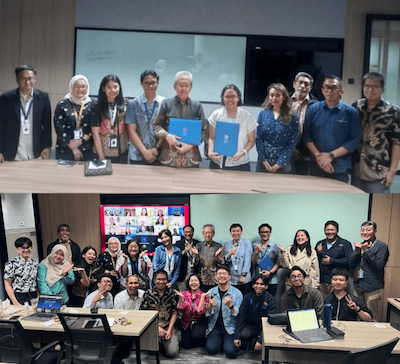
The Indonesian Cyber Media Association (AMSI) and Universitas Multimedia Nusantara (UMN) signed a Memorandum of Understanding (MoU) and a Memorandum of Agreement (MoA) at the Kompas Gramedia Building in Jakarta on Monday (11/5/2026). The cooperation is part of a collaboration between education and the media industry. (doc. Instagram @amsi_id)
The discussion also relates to the ongoing cooperation between AMSI and UMN. The two institutions signed a Memorandum of Understanding (MoU) and a Memorandum of Agreement (MoA) at the Kompas Gramedia Building on 11 May 2026. This collaboration brings education and the media industry together to support an adaptive, innovative, and sustainable press and journalism ecosystem.
For UMN, changes in the media industry are also a concern in journalism education. Andrey believes that learning at university needs to offer not only journalistic theory, but also the range of disciplines that can be developed into specializations suited to the needs of the industry.
“That’s from the education side. What our colleagues in the [Journalism] study program provide isn’t only journalistic theory, but also the various fields of knowledge that can become each person’s specialization,” Andrey concluded.
The AMSI and UMN discussion illustrated the changes the media industry faces in reaching digital audiences. Amid the rise of the news creator and the search for new revenue models, the industry and academic perspectives converge on the need to understand the audience, adapt content distribution, and still maintain a fact-based journalistic process.
By Melinda Chang | UMN News Service
English translation by Levina Chrestella Theodora
Kuliah di Jakarta untuk jurusan Program Studi Informatika | Sistem Informasi | Teknik Komputer | Teknik Elektro | Teknik Fisika | Akuntansi | Manajemen | Komunikasi Strategis | Jurnalistik | Desain Komunikasi Visual | Film dan Animasi | Arsitektur | D3 Perhotelan , di Universitas Multimedia Nusantara. www.umn.ac.id