Expanding Industry Partnerships Again, UMN Officiates Collaboration with Bakrie Center Foundation
June 12, 2026
From Classroom Warmth to Cross-Border Academic Experience: The Story of UMN’s Student Exchange
June 20, 2026UMN Students’ Real Action: Transforming Papringan Market Into a Visitor-Friendly Destination
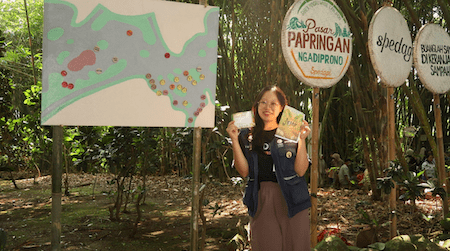
Mahasiswa Program Studi Strategic Communication Universitas Multimedia Nusantara (UMN), Jennyferlius Lis Fernanda, saat berada di Peta Zona 2 Pasar Papringan yang mencakup area kerajinan tangan hingga kuliner. (dok. Jennyferlius Lis Fernanda)
Jennyferlius Lis Fernanda, a student of the Strategic Communication Study Program at Universitas Multimedia Nusantara (UMN), at Zone 2 Map of Papringan Market, which covers areas from handicrafts to culinary delights. (Doc. Jennyferlius Lis Fernanda)
TANGERANG – Jennyferlius Lis Fernanda, a student in the Strategic Communication Study Program at Universitas Multimedia Nusantara (UMN), has developed a zoning-map-based navigation system to help visitors explore Papringan Market in Temanggung, Central Java. This work, which is part of the final assignment for the “Social Impact Initiative (SII)” program, was born from Jenny’s direct experience when she discovered that many visitors had difficulty finding culinary locations and facilities in the market area.
“Each of us must have various ideas when faced with a particular situation. It was the same with me. When I first came to Ngadiprono Hamlet and of course Papringan Market, I was even confused about what to do. But that situation, as well as the experience of directly following the Papringan Market event, made me understand what the needs of the local residents were that I could realize,” Jenny said.
Papringan Market is widely recognized as a community-based tourist destination that attracts thousands of visitors. The unique atmosphere of a bamboo forest gives this market great economic potential for developing a tourism village. However, behind this popularity lie technical obstacles often encountered on the ground.
Jenny said that many visitors often asked the program participants about the location of facilities. In fact, visitors often mistook the students for committee members because of the vests they wore. On the other hand, students also often had difficulty helping distribute logistics to traders because they did not yet understand the complex market layout.
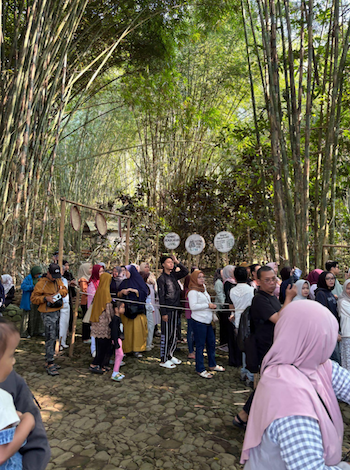
Queues of visitors can be seen at Papringan Market, Temanggung, which is crowded during the event. (Doc. Jennyferlius Lis Fernanda)
This experience became the starting point for the project that Jenny later developed while participating in the program at Papringan Market. She designed a navigation system that was practical yet flexible. She found that the positions of trader stalls at Papringan Market were dynamic, changing with each market event. This made permanent markers difficult to apply.
As a solution, Jenny developed a wooden pin concept that could be adjusted to reflect weekly changes in stall positions. However, the design process did not stop at creating a location map. She also had to adjust the design to the characteristic ever-changing conditions of Papringan Market.
“During the design process, it was found that the positions of stalls can change at each event, making it impossible for the map to use permanent markers. To answer this need, a specially designed wooden pin system was implemented so that it can be moved as needed,” Jenny said.
The map developed by Jenny is divided into three main zones and placed at strategic points in Papringan Market. Besides functioning as an information medium, the map also serves as a communication tool for market managers and visitors to find available locations.
The development process was carried out through discussions with the Spedagi Movement as the initiator and companion of Papringan Market. Various aspects were considered, from material selection to long-term sustainability. The enthusiasm among residents and market managers for this map was quite high because it was considered helpful to visitors, especially those coming for the first time.
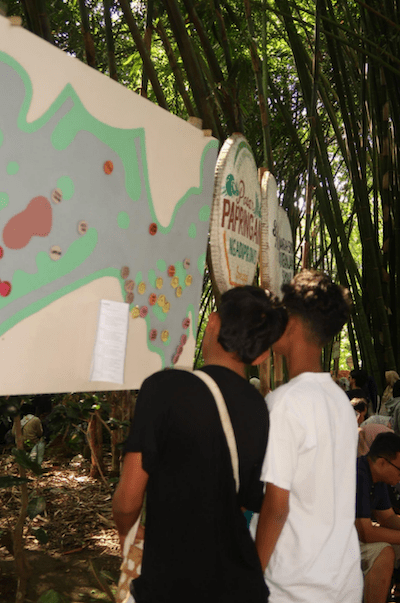
Visitors are seen examining the zoning map at Papringan Market in Temanggung. Zone 2 on the map includes the handicraft area to the culinary area, used as a guide to assist navigation within the market area. (Doc. Jennyferlius Lis Fernanda)
Behind this project’s implementation lies the learning philosophy that underpins the “Social Impact Initiative” program. The Secretary of the UMN Strategic Communication Study Program and a UMN Strategic Communication Lecturer, Irwan Fakhruddin, S.Sn., M.I.Kom., explained that this program is designed to bring students out of the classroom and directly confront social realities in the community.
The “Social Impact Initiative (SII)” is an immersive learning program that integrates academic theory with real fieldwork. Through this program, students are encouraged to understand community needs directly and present solutions that have a real impact on local communities. The program is divided into several project schemes, including Village Revitalization, Humanity Projects, and Social Forestry, designed to encourage students to get directly involved with various social issues in the community.
The program, which runs from April 6 to June 6, 2026, encourages students to live and interact directly with local communities to understand the problem firsthand, what they face, and impactful solutions.
According to Irwan, the “Social Impact Initiative” focuses on transforming students’ character while encouraging real contributions to local communities. This program is one of the distinctive initiatives of the UMN Strategic Communication Study Program that emphasizes the connection between theory and practice.
“We believe that true education will be seen when students can directly provide solutions to social realities and problems, understand social responsibility, and implement all their abilities for the good that has an impact,” Irwan, who is also the initiator of the “Social Impact Initiative” program, said
Before being deployed to the location, students received training covering academic, technical, and community engagement aspects to help them understand the on-the-ground social context. This approach is considered important because most participants come from urban environments and have different experiences from those of rural communities.
Through direct interaction, students are invited to understand community needs before designing relevant and sustainable solutions.
“We refer to three pillars: 1) Humanitarian Value – Empathy & Care, Social Justice & Equality, and Solidarity & Sustainability; 2) Humanistic Approach – Human-centered Learning, Character Building, Global Responsibility; 3) Academic & Community Services – Theory into Practice, Holistic Mentoring, Continuous Reflection,” Irwan explained.
The navigation map was then introduced to visitors through an activity titled “Susur Jejak Papringan” (Tracing Papringan’s Footsteps), which invited participants to explore various points in the market using the map guide while getting to know the elements that shape the distinctive Papringan Market experience.
For Jenny, one of the most memorable moments came when she saw visitors begin interacting directly with the map she had designed. That response became an early sign that the community was truly using the solution she developed.
Besides being used to find culinary locations, the map attracted visitors who stopped to observe its details, even using it as a backdrop for photos. This experience reinforced Jenny’s belief that simple ideas can grow into impactful solutions when put into practice.
“I hope my fellow UMN students dare to pour out their ideas and realize them into real work,” Jenny said.
In line with that, Irwan emphasized that educational success is measured not only by academic achievement but also by students’ ability to combine competence with social concern. Through the “Social Impact Initiative,” students are encouraged to learn alongside the community and make community needs the basis for developing solutions.
“The main principles that must be held are ‘Learning by Doing’ – on-site learning, real situation exposure, and real simulation; Community-Based – ensuring community participation as the basis for creating solutions (bottom-up approach), no ‘I’ but ‘WE’. Always be humble, always hold the philosophy of ‘when in Rome, do as the Romans do’, make yourself an empty glass wherever and whenever,” Irwan said.
By Melinda Chang | UMN News Service
English translation by Levina Chrestella Theodora
Kuliah di Jakarta untuk jurusan program studi Informatika| Sistem Informasi | Teknik Komputer | Teknik Elektro | Teknik Fisika | Akuntansi | Manajemen| Komunikasi Strategis | Jurnalistik | Desain Komunikasi Visual | Film dan Animasi | Arsitektur | D3 Perhotelan , di Universitas Multimedia Nusantara.