From a Communication Studies Major at UMN to Senior Marketing Communications Manager at a Five-Star Hotel: Ananda Wondo’s Career Journey
September 12, 2026From Seaweed Farmers’ Challenges, Three UMN Students from Different Study Programs Win Entrepreneurial Excellence in Vietnam
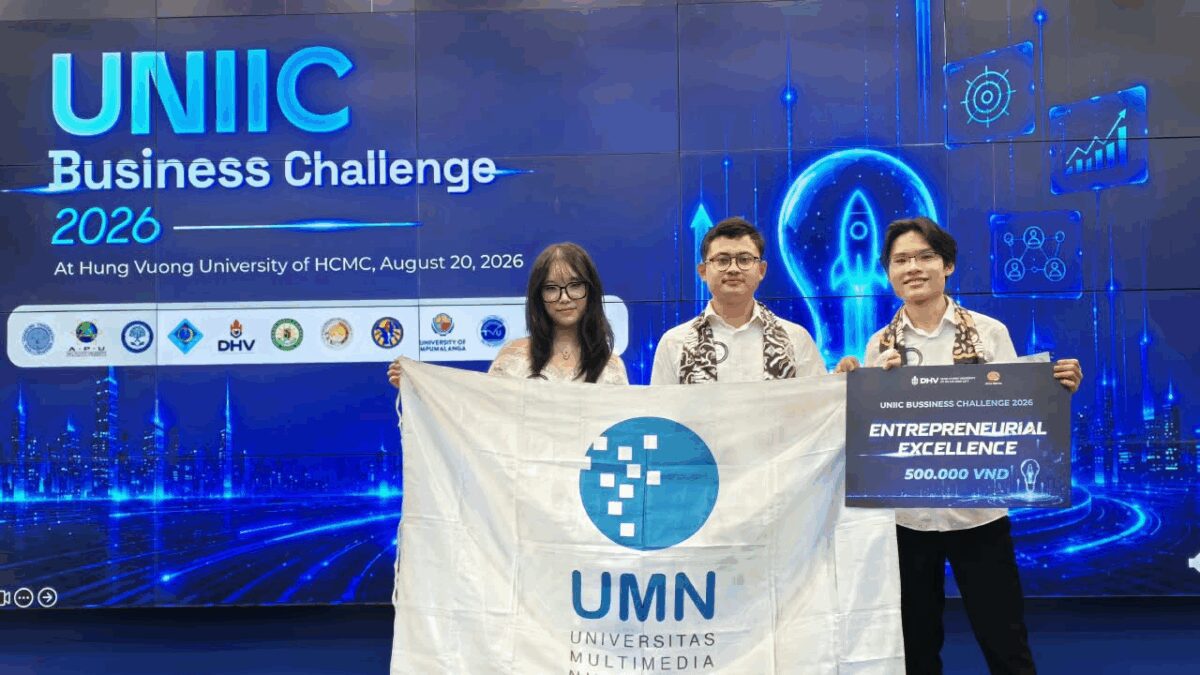
Mahasiswa UMN Mirabell Stacy Quan, Muhammad Faiq Hakim Ulinnuha, dan Peter Huang (kiri ke kanan) saat menerima penghargaan Entrepreneurial Excellence dalam UNIIC Business Challenge 2026 di Ho Chi Minh City, Vietnam, pada 20 Agustus 2026. (dok. Peter Huang)
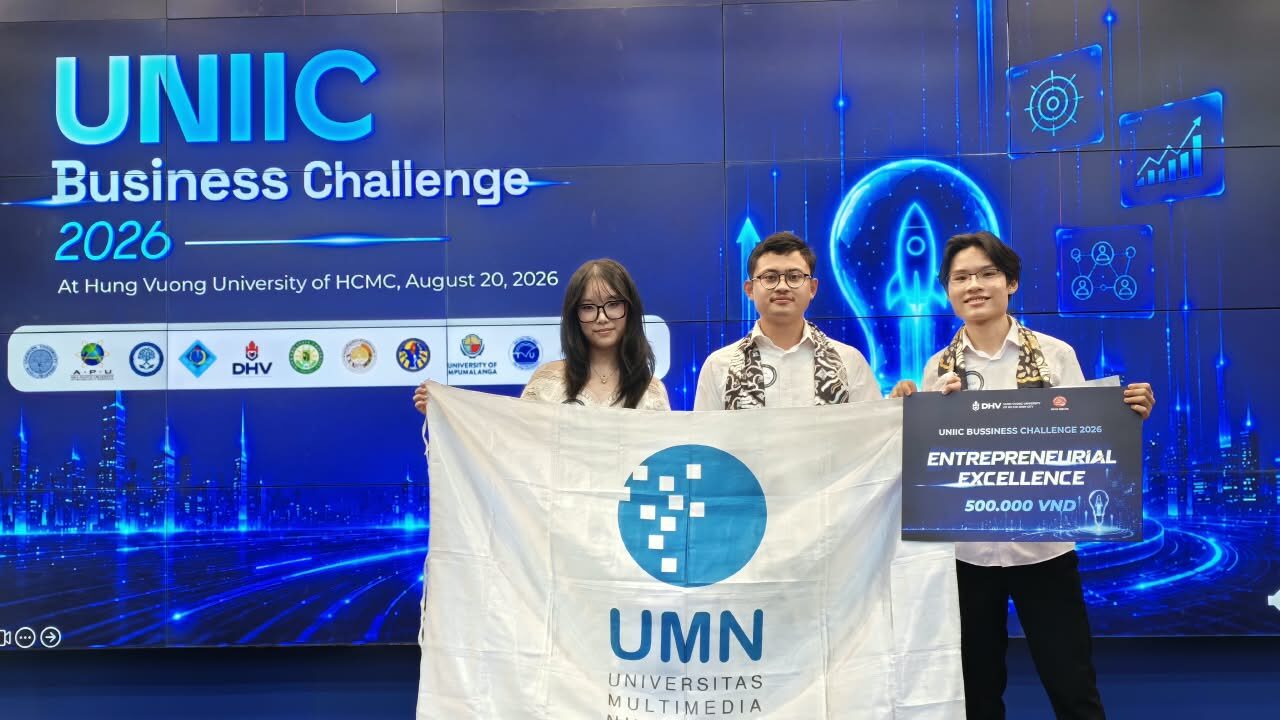
UMN students Mirabell Stacy Quan, Muhammad Faiq Hakim Ulinnuha, and Peter Huang (left to right) while receiving the Entrepreneurial Excellence award at the UNIIC Business Challenge 2026 in Ho Chi Minh City, Vietnam, on August 20, 2026. (doc. Peter Huang)
TANGERANG – Three students from Universitas Multimedia Nusantara (UMN) successfully won Entrepreneurial Excellence at the UNIIC Business Challenge 2026, held in Ho Chi Minh City, Vietnam, on Thursday (20/08/2026). The achievement was earned by Peter Huang from the UMN Management Study Program, class of 2024, Mirabell Stacy Quan from the UMN Visual Communication Design (VCD) Study Program, class of 2024, and Muhammad Faiq Hakim Ulinnuha from the Information Systems Study Program, class of 2023, through a business idea that seeks to address challenges faced by seaweed farmers by combining business strategy, technology, and design.
The three students did not simply divide tasks based on their respective academic backgrounds. Peter focused on business strategy and financial projections, Hakim developed the technological aspects through applications, websites, and AI integration, while Mirabell translated the idea into branding and visual presentations. The combination of these three perspectives became one of their strengths in developing a solution that enabled them to compete in an international business competition.
The UNIIC Business Challenge 2026 is an international business competition held annually by the University Incubation and Innovation Consortium (UNIIC). This year, the competition was held at Hung Vuong University (DHV), Ho Chi Minh City, Vietnam, and was attended by nearly 100 students from 12 universities across the Philippines, Malaysia, Vietnam, Cambodia, South Africa, and Indonesia.
In the competition, participants were required to present a business idea within six minutes based on one of the designated theme pools: Improving Communities, Harnessing Technologies, and Resource Scarcity. The UMN team competed in the Improving Communities pool, which required participants to present business value for a particular community with potential for future sustainability.
Through brainstorming and research into various issues that could be faced by Indonesian communities, the team ultimately chose to address challenges in the seaweed industry. They identified issues faced by farmers, including low income due to an unfair distribution of profits and problems related to price and quality ratios. On the other hand, buyers also face difficulties because they have to obtain seaweed with unsorted and uncertain quality, requiring additional time and costs to obtain the appropriate quality.
Based on these issues, the team designed a business that connects carrageenan producers with seaweed farmers. The solution aims to provide consumers with seaweed whose quality has been assessed while also providing higher payments for farmers. To ensure that the idea had business potential, they then considered various aspects, ranging from the problems faced, target market, and competitors to the business model.
“Our solution was a business that connects carrageenan producers with seaweed farmers. Providing graded quality seaweed to consumers and higher pay for seaweed farmers,” said Mirabell.
The issue addressed by the team did not stop at seaweed quality. According to Purnamaningsih, S.E., M.S.M., Head of the UMN Management Study Program, one of the team’s strengths was their ability to define the problem more deeply. The team identified the ijon system in the seaweed supply chain as part of a structural issue that leaves farmers dependent on intermediaries.
In addition to refining the problem, the team also revised the business model and financial projections several times. This process was carried out to ensure that the idea was not only conceptually appealing, but also supported by detailed and accountable business fundamentals.
“The main strength of this team is how their three academic backgrounds truly complement one another, rather than simply dividing the tasks: Peter from Management led the business strategy and financial model, Hakim from Information Systems translated the idea into a realistic technical solution that could be implemented, and Mirabell from VCD ensured that the story was conveyed visually and clearly to the judges. This allowed the team to avoid a common problem among students: having a good idea but weak presentation execution, or vice versa,” said Purnamaningsih.
For Peter, the collaborative process demonstrated how perspectives from different fields can make an idea that initially exists only as a concept more feasible and realistic. Input from the Information Systems and VCD fields also influenced how the business could be implemented through technology while being communicated in a more engaging way.
In the solution they developed, technology became one of the main supporting elements. The team used e-commerce to accelerate the buying and selling process among various parties while supporting transparency. In addition, they used computer vision to accelerate the quality assessment process and support credibility through documented data.
The technology was also developed by considering perspectives from the other two fields. Management knowledge was needed to understand financial aspects and the buying and selling process, while input from VCD helped ensure that the technology had a user-friendly interface and supported the business branding.
“Technology is a very important support for the business model we brought. There are two technologies used, namely e-commerce and computer vision. E-commerce is used to accelerate the buying and selling process among various parties and ensure transparency, while computer vision is used to accelerate the assessment process and ensure credibility because everything is properly documented without bias,” Peter explained.
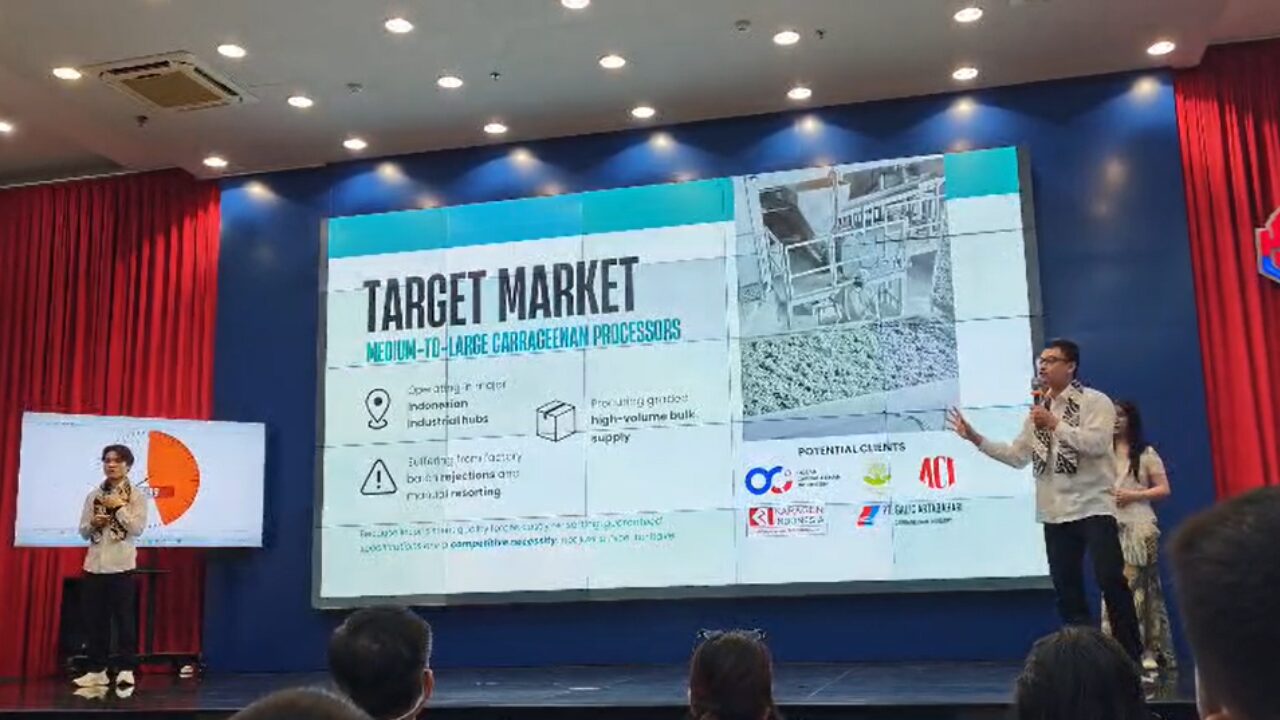
UMN student team presenting their business idea at the UNIIC Business Challenge 2026 in Ho Chi Minh City, Vietnam. (doc. Peter Huang)
The technological perspective was also combined with a design that considered the stages of implementation in the field. According to Purnamaningsih, the solution developed by Hakim translated the ijon issue and manual grading process into stages that were more realistic to implement. The process was designed to begin with manual grading by field agents in the first year, followed by plans for automation using AI in subsequent years.
Meanwhile, the VCD perspective played a role in translating data and technical aspects into a more accessible visual presentation and narrative. This was not only intended for the competition presentation, but also considered the parties who would eventually interact with the solution, ranging from farmers and cooperatives to investors.
“This diversity of academic backgrounds is clearly reflected when we look at the final solution they produced, not just in the division of tasks. Peter’s business perspective ensured that the solution had a commercially viable model, from a revenue-sharing scheme with cooperatives to realistic financial projections with accountable figures,” Purnamaningsih stated.
For Mirabell, translating the business idea into a visual identity began with understanding the values that a brand wanted to convey and how consumers were expected to perceive it. She then developed an identity consisting of a logo, color palette, and visual style tailored to the character of the business, which aimed to be a professional and trustworthy brand that brings hope for the community to develop.
Working with Management and Information Systems students also allowed Mirabell to see that a design can be perceived differently by people from different backgrounds. Feedback from her team members became part of the process of understanding how a design could be accepted by a broader audience.
“For translating the business idea into something visual, of course it starts from brainstorming what values our brand wants to portray and how we want our customers to view us. Afterwards, I made the brand identity like logos, color palette, and overall style, to fit the values of the brand, in this case a more professional, trustworthy brand that brings hope to the community to regenerate and grow,” said Mirabell.
To reach the stage where they were ready to present at an international competition, the team went through a fairly lengthy development process. They began by brainstorming various ideas brought forward by each member. After selecting the idea to be developed, they conducted research and analysis on the problem, target market, competitors, and business model.
The biggest challenge arose when they had to learn about an industry they had never directly worked in before. This required the team to make numerous revisions regarding how the business would operate, generate profits, and anticipate various potential problems in the future. Teamwork and input from lecturers then helped them refine the business plan that would be presented.
“The process began with brainstorming many ideas presented by each member. After deciding on the idea we wanted to pursue, we conducted research and analysis of every aspect, from the problem, target market, and competitors to the business model,” said Peter.
According to Purnamaningsih, the process demonstrated that cross-disciplinary collaboration can provide significant added value when an idea is developed into a solution. A creative idea needs to be tested from various perspectives, ranging from its potential to generate sustainable revenue, the feasibility of building the solution technically, to how its benefits can be communicated to different stakeholders.
Collaboration also allowed each member to question and test the ideas from the beginning. As a result, gaps that might not have been visible if the idea had been developed within a single academic field could be identified and improved before the solution was brought to the competition.
“This team’s experience shows that cross-disciplinary collaboration provides very significant added value in developing an idea into a solution,” Purnamaningsih explained.
When facing the judges, the team highlighted the real challenges experienced by the seaweed farming community. They then combined these challenges with the application of technology, a realistic business design, and the ability to communicate the idea through a structured pitch. This combination was one of the factors that they believed contributed to their achievement of Entrepreneurial Excellence.
“We highlighted a real problem that is strongly experienced by a particular community, namely seaweed farmers. With good technology implementation, a realistic business approach, and a smooth pitch, these factors contributed greatly to our success in achieving Entrepreneurial Excellence,” said Peter.
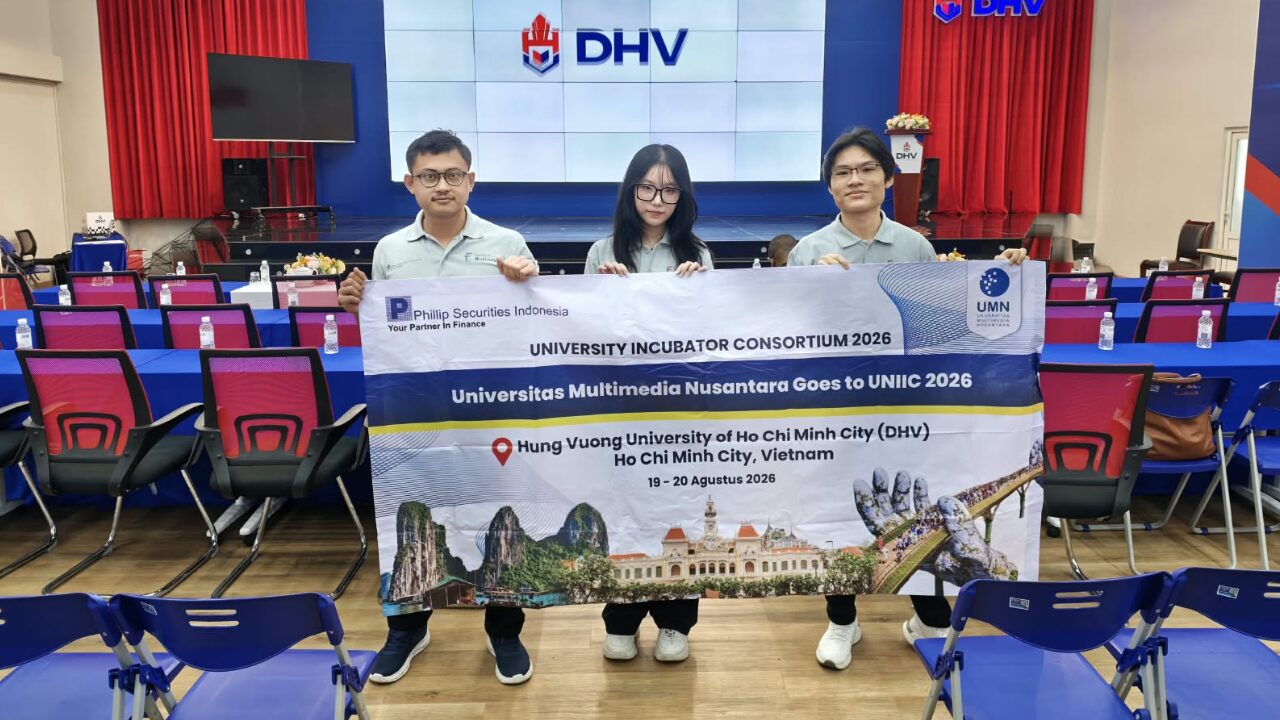
UMN students Muhammad Faiq Hakim Ulinnuha, Mirabell Stacy Quan, and Peter Huang (left to right) posing together after receiving the Entrepreneurial Excellence award at the UNIIC Business Challenge 2026 in Ho Chi Minh City, Vietnam, on August 20, 2026. (doc. Peter Huang)
The experience of bringing their project to an international competition also gave the three students a different perspective on the opportunities provided by UMN. Peter considered the opportunity to participate in the competition with a faculty advisor, along with financial support, to be an encouragement for students to continue creating and participating in competitions at both national and international levels.
For Mirabell, the opportunity to participate in an international business competition was something that previously felt out of reach. Support from lecturers and teammates made her feel that she had people who could guide her throughout the process, giving her more confidence to present her work to others.
“I think that UMN opened up this opportunity for me because I would have never thought to apply to an international competition on my own, especially one about a business pitch since it seemed far out of reach. However, through UMN the competition itself didn’t feel as far or unreachable since I had people helping me throughout and guiding me such as my lecturers and teammates. I think that the support UMN has given me was the push I needed to be brave enough to put my works out for others to see,” said Mirabell.
By Melinda Chang | UMN News Service
Study in Jakarta in the following study programs: Informatics | Information Systems | Computer Engineering | Electrical Engineering | Engineering Physics | Accounting | Management | Strategic Communication | Journalism | Visual Communication Design | Film and Animation | Architecture | Diploma in Hospitality, at Universitas Multimedia Nusantara.