Expanding Global Networks, UMN Discusses Collaboration Opportunities with The Italian Embassy to Indonesia and Uni-Italia
May 14, 2026
UMN MMT Students Realize Humanitarian Action Through Blood Donation Program at National Label
May 14, 2026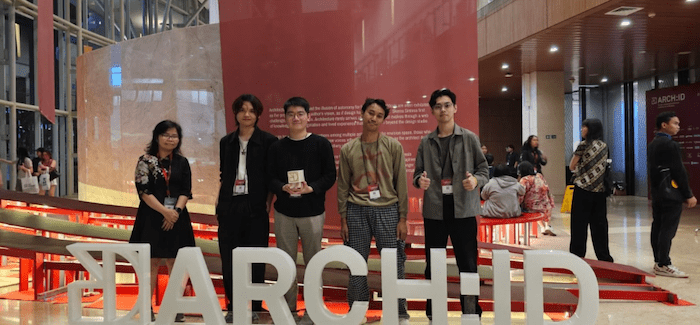
UMN student team together with their supervising lecturer, Ar. Irma Desiyana, S.Ars., M.Arch., pose for a photo after achieving first place at the Hackathon #1 ARCH:ID 2026.
TANGERANG – Students from the Architecture and Engineering Physics programs at Universitas Multimedia Nusantara (UMN) have once again achieved a national-level accomplishment. The team, consisting of Justin Christian Hamzah, Gilig Setyo Rahardjo, Farhan Sidqi Purnawan, and Nicholas Pranata, won 1st place at Hackathon #1 ARCH:ID 2026 under the theme “Climate-Responsive Transit-Oriented Housing,” held at ICE BSD City on April 24, 2026.
In this one-day competition, participants were challenged to design vertical housing in line with Transit-Oriented Development (TOD) in the MRT Blok A area, South Jakarta, using Autodesk Forma as the primary tool for design exploration and environmental simulation. Participants were required not only to produce an aesthetically pleasing design but also to address urban issues, integrate public transportation, and address climate challenges through a data-driven approach.
For the UMN team, this victory was not merely about creating a visually appealing design. From the outset, they aimed to present a design capable of addressing area connectivity, the community’s socio-economic needs, and site microclimate conditions—issues that are increasingly relevant amid climate change concerns.
“We tried to present a design with a concept focused on solving urban problems: regional connectivity, functions that are contextual to the area’s needs, and building massing that responds to the site’s microclimate. We attempted to integrate these three main focuses so that the overall design outcome is not only good (pleasing to the eye) but also correct, appropriate, and precise,” said Justin Christian Hamzah, a 2022 batch Architecture student at UMN.
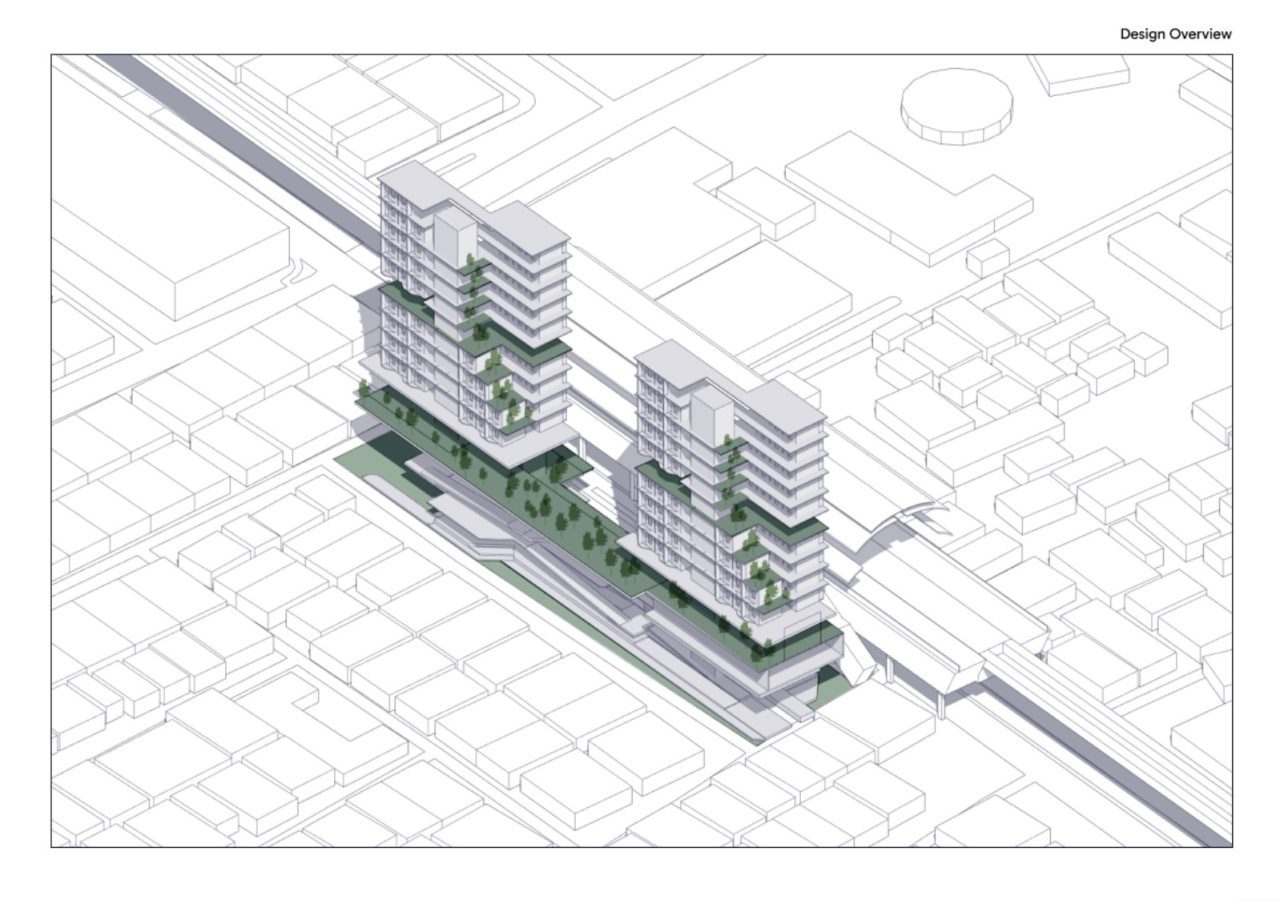
The Climate-Responsive Transit-Oriented Housing design by the UMN student team combines residential functions, public spaces, and public transportation integration within an area responsive to Jakarta’s climatic conditions.
This concept was then developed into a vertical housing design that does not stand as a mere exclusive building but becomes part of the public mobility ecosystem in the MRT Blok A area. The team sees the development of public transportation in Jakarta as an opportunity to create better-integrated living spaces with people’s daily activities.
Through this design, residents and MRT users are envisioned to be able to move directly from the transportation area into the building without having to exit the station area. This approach is considered capable of encouraging public transportation use while simultaneously creating new social and economic connections in the surrounding area.
“Our building must first be ‘correct’ in addressing the area’s problems and responding to Jakarta’s climate before it can truly be ‘presented’,”Gilig Setyo Rahardjo, a 2021 batch Architecture student at UMN, said.
Not stopping at area integration, the team also paid great attention to thermal comfort issues and building responsiveness to Jakarta’s tropical climate. During the design development process, they used Autodesk Forma to simulate various environmental parameters, including sun exposure, air humidity, wind speed, and thermal comfort levels.
This simulation-based approach became one of the key strengths of their work. The design process did not proceed linearly but involved multiple iterations and tests to identify the optimal building configuration.
“Climate change is no longer just a ‘concept’ that will happen; it is something we are all already living through. Therefore, as designers, it is our responsibility and obligation to respond to this to ensure that future planning is not only functional but also livable and usable for people,” Justin said.
In this process, Nicholas Pranata from UMN’s Engineering Physics program played a crucial role in ensuring the design was truly environmentally responsive. Nicholas helped the team translate building physics data into design considerations that the architecture team could apply directly.
Using parameter-based simulations, such as Wet-Bulb Globe Temperature (WBGT), Universal Thermal Climate Index (UTCI), wind speed, and air humidity, the team identified areas that could cause discomfort for residents. This data was then used to determine spatial functions and natural ventilation strategies within the building.
“Collaboration between engineering physics and architecture will continue to be needed to achieve these two SDG goals,” said Nicholas Pranata, a 2021 batch UMN Engineering Physics student, referring to Sustainable Development Goals (SDGs) number 9 (Industry, Innovation, and Infrastructure) and number 11 (Sustainable Cities and Communities).
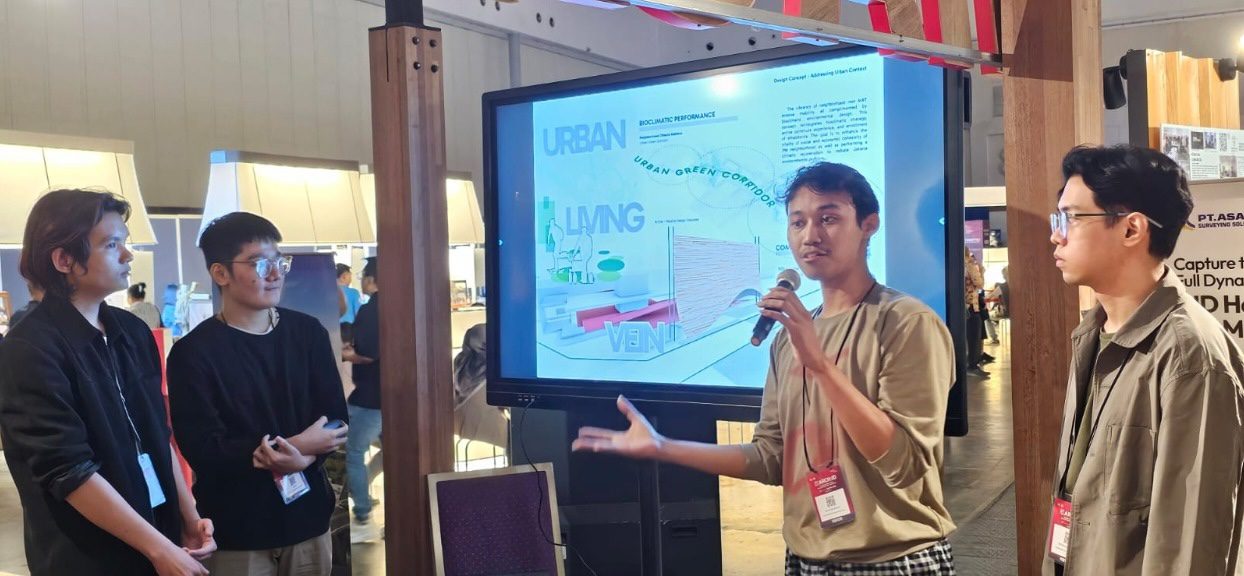
The UMN student team presenting their Climate-Responsive Transit-Oriented Housing concept at the ARCH:ID 2026 Hackathon at ICE BSD City, Friday (April 24, 2026).
This cross-disciplinary collaboration has also become an important focus within UMN’s Faculty of Engineering and Informatics (FTI). The Dean of FTI UMN, Dr. Eng. Niki Prastomo, S.T., M.Sc., believes that this victory demonstrates that learning at UMN is increasingly relevant to industry needs and future challenges.
According to him, students are not only equipped with theoretical understanding but also with the ability to work on cross-disciplinary teams, apply knowledge in real-world contexts, and produce solutions that are applicable and impactful.
“Architecture is strong in spatial design, user context, and built environment quality, while Engineering Physics strengthens aspects of building performance, thermal comfort, energy efficiency, and technical analysis. When the two collaborate, the resulting solutions become more holistic, creative, measurable, and impactful,” Niki said.
A similar sentiment was expressed by the Head of UMN’s Architecture Program, Hedista Rani Pranata, S.Ars., M.Ars. She revealed that collaboration between Architecture and Engineering Physics at UMN has actually been ongoing through various academic activities, ranging from exchange lectures to joint faculty research.
In the future, UMN is exploring the possibility of collaborative final theses across study programs to strengthen the multidisciplinary approach to addressing industry challenges and sustainability issues.
“Actually, we have had quite close ties through exchange lectures and joint faculty research. We are even currently developing a system for collaborative final theses across programs [UMN Architecture and UMN Engineering Physics], because these two programs share similar concerns,” Hedista said.
For Justin and the team, this victory serves as a sweet ending to their journey participating in ARCH:ID as active students. After previously winning 2nd place in a similar competition last year, they brought home the top prize this year.
“The feeling is certainly very grateful and happy, especially because this is our last year to participate in the ARCH:ID Hackathon as active students, and this year we were able to win 1st place,” Justin said.
By Melinda Chang | UMN News Service
English translation by Levina Chrestella Theodora
Kuliah di Jakarta untuk jurusan program studi Informatika| Sistem Informasi | Teknik Komputer | Teknik Elektro | Teknik Fisika | Akuntansi | Manajemen| Komunikasi Strategis | Jurnalistik | Desain Komunikasi Visual | Film dan Animasi | Arsitektur | D3 Perhotelan , di Universitas Multimedia Nusantara.