
Integration of Environmental Sustainability in the Academic Curriculum
December 30, 2025
New Year, New Me: It’s Time for Students to Prepare Their Data Skills for 2026
January 6, 2026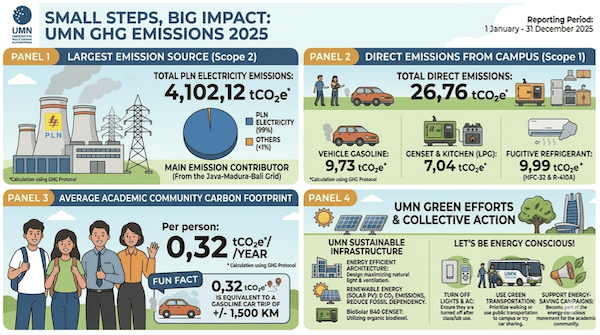
*Created with AI assistance and manually refined
Tangerang, (03/01/2026) – The Center for Sustainability at UMN is strengthening its approach to carbon emission management through more structured and data-driven measurement. This effort aims to better understand the university’s emission profile comprehensively and serve as a foundation for designing targeted emission reduction strategies.
Carbon emissions are one of the main contributors to global climate change. Since its establishment, the Center for Sustainability at UMN has developed various sustainability initiatives involving the entire academic community, including collaboration with related departments in collecting data and managing carbon emissions within the campus environment.
“Energy management efforts have been optimized starting in 2025, in line with the full utilization of UMN buildings. This calculation process also involves several study programs to analyze data from multiple perspectives and deepen the analysis,” said Maria Advenita Gita Elmada, Manager of the Center for Sustainability UMN.
According to Maria, this approach not only focuses on operational aspects but is also integrated into the learning process. Education on carbon emission reduction is introduced to students through the Sustainability 101 program, a mandatory short course for all UMN students. Through this program, students gain an understanding of carbon footprints and are encouraged to be more mindful in considering energy use in their daily lives and future decisions.
Students are provided with education on reducing carbon emissions, with the expectation that they will make more informed decisions regarding energy use in the future.
“Based on calculations from Building Management, UMN’s short-term plan is to reduce electricity consumption by 2% from the 2025 baseline. This target will begin implementation in 2026 through strengthened operational policies, optimized facility usage, and improved efficiency in building-level electricity consumption,” Maria explained.
In addition to technical approaches, Maria also emphasized the importance of behavior-based interventions through campus campaigns. These efforts aim to encourage changes in energy consumption habits among the academic community.
“Some initiatives that have been implemented include education on facility usage such as elevator button efficiency, promotion of car sharing practices, reduction of electricity usage through simple habits like unplugging devices when not in use, replacing conventional lighting with LED, and integrating sustainability campaigns into various courses and student organizations,” she added.
This approach is supported by emission calculations based on the Greenhouse Gas (GHG) Protocol in 2025. Based on the inventory results, UMN’s emission intensity is recorded at 0.32 tCO₂e per academic community member, which serves as the baseline for future emission management.
“We use the emission intensity figure of 0.32 tCO₂e per academic community member as our starting point. Benchmarking is continuously conducted by referring to studies and emission calculation practices at various universities. In this context, UMN’s current position can be considered relatively efficient, although there is still room for improvement, particularly in electricity consumption,” Maria stated.
“The calculation results show that the largest emission contribution at UMN currently comes from electricity usage as the primary source of campus operations. This reflects the nature of university activities, which depend heavily on energy to support learning and operational activities, thus making energy efficiency and electricity management key intervention areas,” she continued.
Looking ahead, Maria emphasized that emission management does not solely depend on systems, but also on the involvement of the academic community. Therefore, educational approaches and awareness-raising remain essential components of the implemented strategy.
“Emission reduction efforts require collective participation. Behavioral changes in energy usage are a key factor in supporting the effectiveness of the strategies that have been designed,” she said.
Moving forward, UMN will continue to develop its emission measurement approach in accordance with the GHG Protocol standards. Maria noted that UMN has begun gradually developing calculations for certain Scope 3 emissions, including water and waste aspects, to achieve a more comprehensive emission profile.
“In responding to increasingly significant climate change, we will continue to optimize the use of technology such as sensors for electricity management, strengthen research, and enhance awareness among the academic community through knowledge-based approaches,” Maria concluded.