From AI-Based Marriage Counseling to Plastic Bricks, UMN MMT Students Sweep The Boards at The ASEAN Competition
November 27, 2025
UMN Officially Partners with The Government of Banggai, Central Sulawesi
December 5, 2025
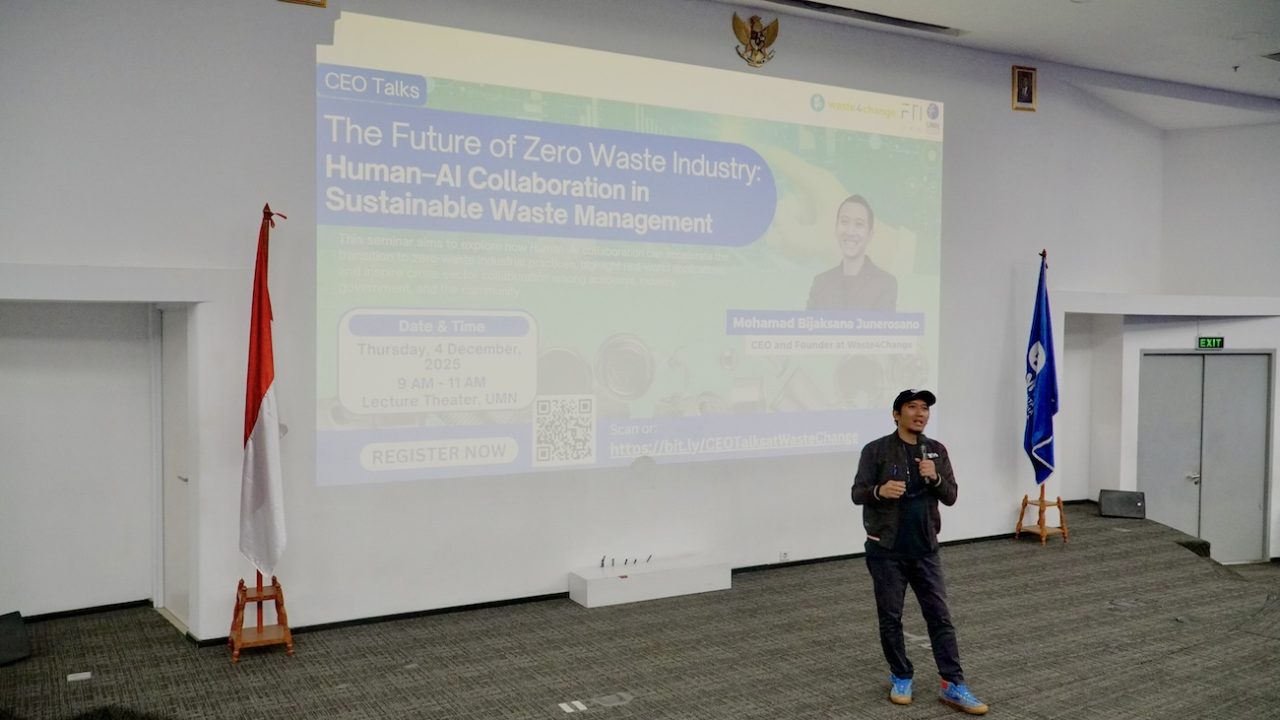
Faculty of Engineering and Informatics UMN CEO Talks with Sano. (Doc. UMN)
Tangerang, (November 4, 2025) – The Faculty of Engineering and Informatics (Fakultas Teknik Informatika/FTI) UMN held a seminar with the CEO and Founder of Waste4Change, Mohamad Bijaksana Junerosano, also known as Sano. Addressing the broader topic of sustainability, Sano also highlighted the importance of collaboration between humans and Artificial Intelligence in supporting a better Earth. This seminar also served as an enrichment for the 2025 National Young Researchers Competition hosted by UMN.
Currently, sustainability issues have become a topic of widespread community discussion, not merely a vision of the United Nations (UN) for the future of the world. However, given the reality of the world, where the climate is worsening, and disasters caused by human actions are rampant. On this occasion, Sano discussed waste management strategies that the Indonesian people can implement.
“We see that the current issue that is very close to Indonesia is the problem of waste. Some people only think about throwing their trash in the trash bin so that their house is clean. But they don’t think about where the trash goes after that and how it is processed. This problem has not been solved even though Indonesia has had three presidents,” Sano said.
Sano himself is actively initiating efforts to improve waste management in Indonesia. In addition to Waste4Change, he also outlined strategies that can be implemented in Indonesia, namely by looking at each layer of the region, from villages to cities to regions. This is important so that waste management can be aligned with the regional budget.
“In fact, the regional budget is not sufficient to address waste issues, considering other priorities such as education and public health. If forced, it will sacrifice these important things as well. So what can be done? Promote a circular economy, recycle existing products, and make this work a professional profession,” he explained.
For Sano, the future profession with high, massive opportunities in Indonesia is Extended Producer Responsibility (EPR). The role encourages producers and industries to drive a circular and sustainable economy. This is in line with the activities carried out by Waste4Change in mobilizing and recycling waste into something new that can create new business opportunities.
The important role of education and technology in waste management
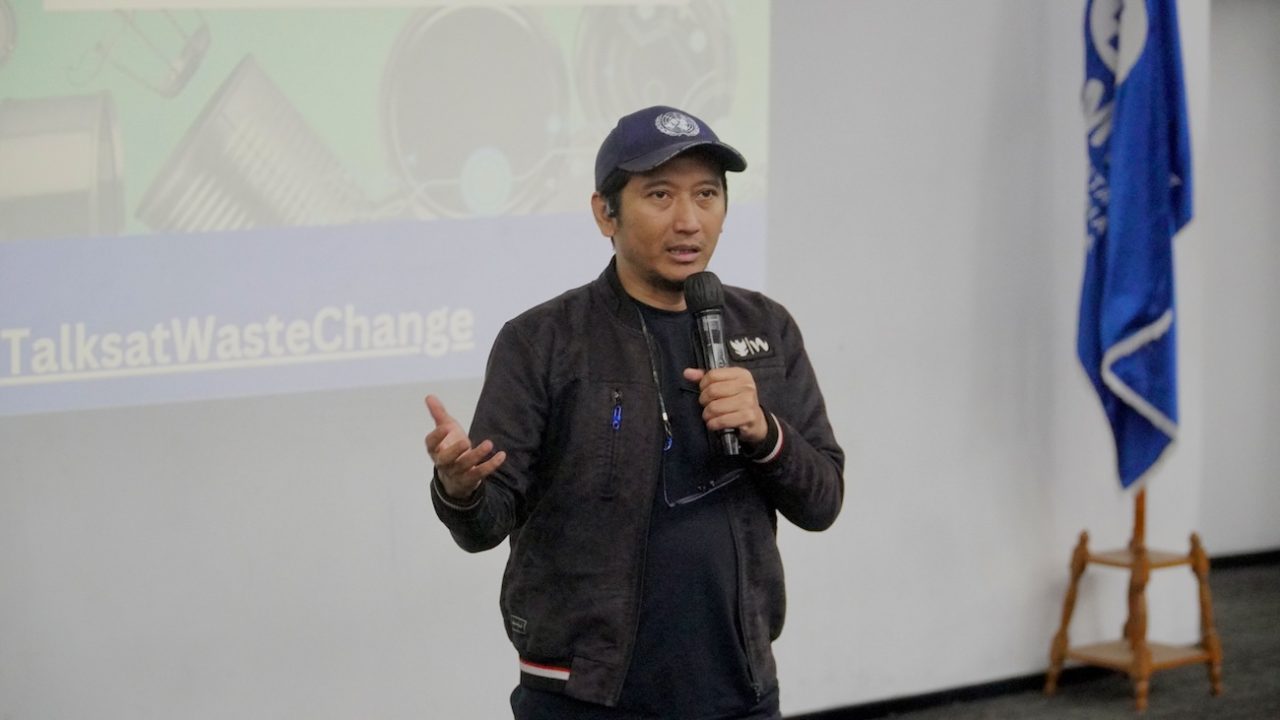
Sano during his presentation at CEO Talks FTI UMN. (Doc. UMN)
Sano emphasized the importance of education and the integration of Artificial Intelligence (AI) technology for waste management. For Sano, research and education on sustainability must be applied to children from an early age.
“In educating, we can start with small steps, and the education sector actually has a pretty important role in this. Starting from categorizing types of waste, managing organic waste into compost, replacing products that can be reused, and various other initiatives,” Sano explained.
Sano added that if the Indonesian people are consistently educated about proper waste management, Indonesia can and will be waste-free in the future. In addition to the community, educational institutions, industry, and the government play an important role, so it is hoped that there will be even broader collaboration.
“Educational institutions make a big contribution because they are the creators of research and journals. We must not let this research end up in libraries and not be implemented in the community. Expand relationships; schools and universities can collaborate to encourage impactful research,” Sano explained.
In addition to human collaboration, Sano also emphasized collaboration with technology. Seeing the advancement of technology, this is also an excellent opportunity for humans to increase productivity. AI technology is not designed to replace humans, but rather to assist human work.
“AI can be an accelerator. I myself work faster, more effectively, and more efficiently, so that the services we provide can be more affordable and accessible to many people. Interestingly, AI can help us study sustainability and waste issues in depth, enabling us to find the right solutions. I think this can also help make research more efficient and in-depth,” Sano said.
Sano further explained that Waste4Change’s work system already uses digitalization to process data, which is a significant and valuable asset for the future. However, Sano also advised that we cannot rely 100% on AI, considering that technology is only a tool. Humans still have a fundamental role to play.
“With the use of AI, we must remain wise and use it for positive purposes. All tools in this world can basically be used for good or bad. It’s like a spoon can be used for eating, but it can also be used to hit someone, depending on the person,” he added.
Sano also left a message for the seminar participants, encouraging them to continue thinking critically, innovatively, and analytically. These skills also need to be passed on to children in the future, so that the next generation will not depend on AI and will have sharp minds.
By Rachel Tiffany | UMN News Service
English translation by Levina Chrestella Theodora
Kuliah di Jakarta untuk jurusan program studi Informatika| Sistem Informasi | Teknik Komputer | Teknik Elektro | Teknik Fisika | Akuntansi | Manajemen| Komunikasi Strategis | Jurnalistik | Desain Komunikasi Visual | Film dan Animasi | Arsitektur | D3 Perhotelan , di Universitas Multimedia Nusantara.