
Communication Studies Students Must Also Be Proficient in Data Analytics—Here’s Why!
November 27, 2026
Skystar Ventures Helps PanivieLab Excel at KANVAS 2026
November 27, 2026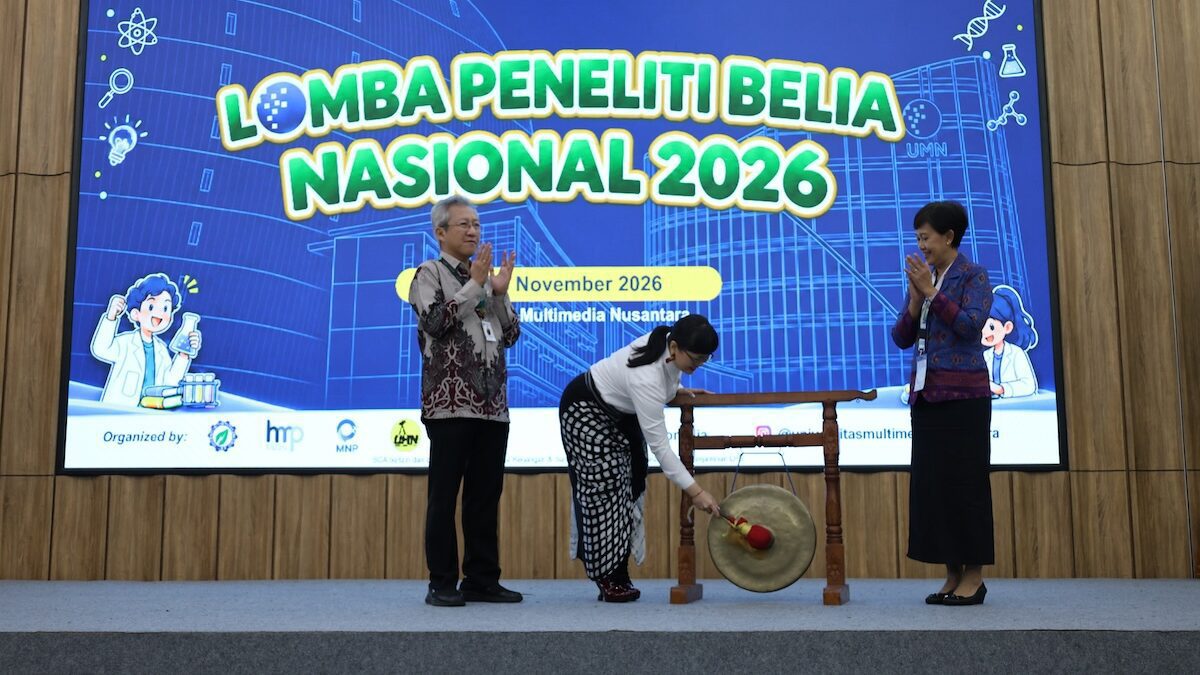
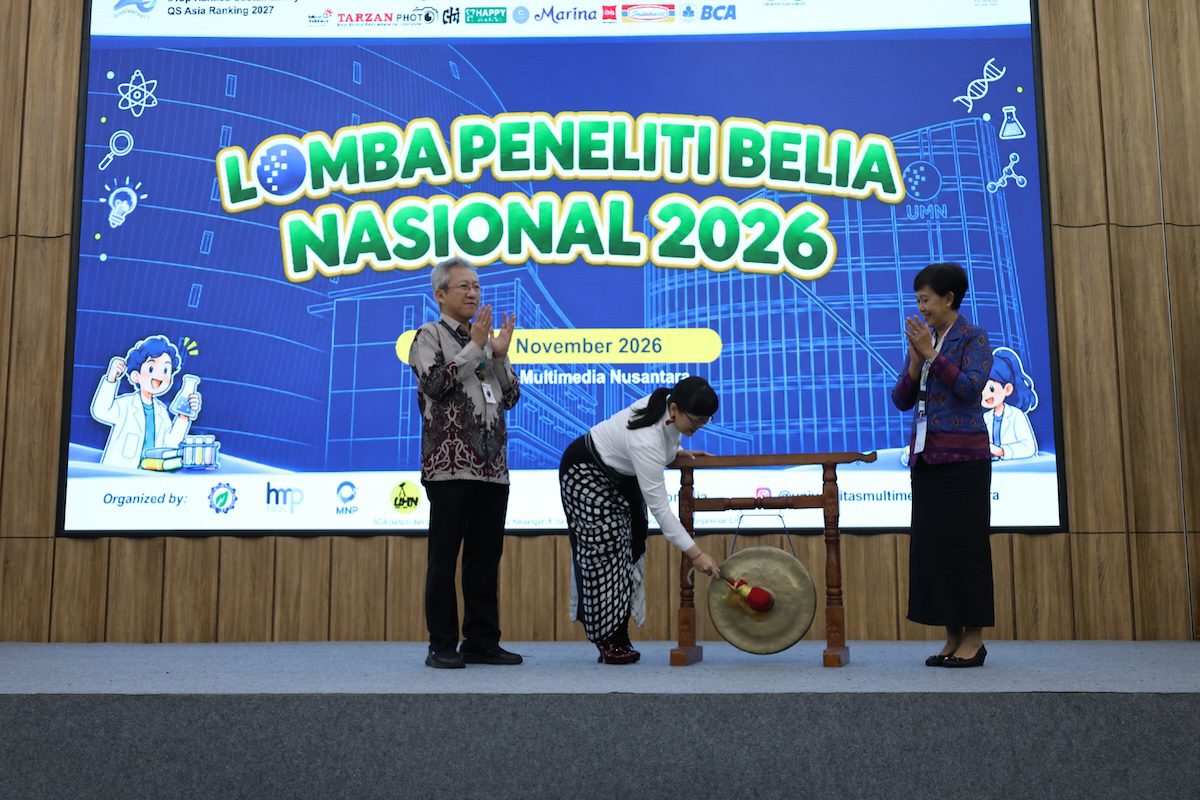
Prof. Stella Christie Strikes the Gong to Mark the Start of the 2026 National Youth Research Competition (Photo: UMN CorCom)
Tangerang, (November 25, 2026) – The Faculty of Engineering and Informatics at Universitas Multimedia Nusantara (FTI UMN), in collaboration with the Center for Young Scientists (CYS), once again organized the 2026 National Youth Research Competition (LPB). This event received support from Prof. Stella Christie, A.B., Ph.D., Deputy Minister of Higher Education, Science, and Technology of the Republic of Indonesia, as part of efforts to foster a culture of research and innovation from an early age among the younger generation. The National Round of the 2026 LPB serves as a platform for young researchers in junior high and high school to present their research findings and exchange ideas.
This year, the 2026 National LPB served not only as a competition but also as a research conference for middle and high school students across 10 research fields: Physics, Mathematics, Computer Science, Environmental Science, Life Sciences, Economics, Geography, History, Sociology, and Psychology. The event was attended by 262 research teams, 482 student researchers, 113 schools, 216 supervising teachers, and 33 faculty members from various universities serving as judges.
Hosting the 2026 National Youth Research Competition on the UMN campus is one way UMN demonstrates its commitment to supporting the sustainability of the research and innovation ecosystem, particularly through quality education. This commitment is realized not only through education for university students but also for middle and high school students. As a token of appreciation for the achievements of the 2026 National Youth Research Competition participants, UMN provided support in the form of tuition waivers: 100% for the first-place winner, 75% for the second-place winner, and 50% for the third-place winner.
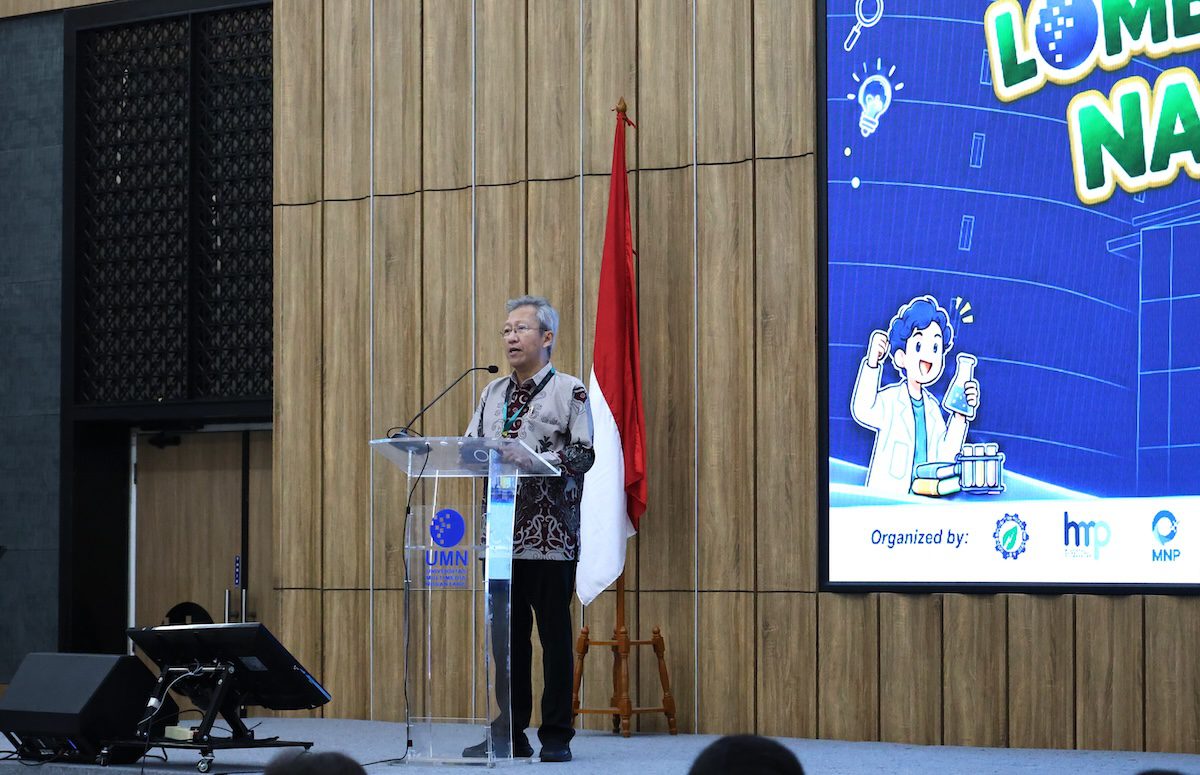
UMN Rector Andrey Andoko Delivers Remarks at the 2026 National Young Researchers Competition (Photo: UMN CorCom)
“Today’s world is becoming increasingly complex due to rapid technological advancements. Research should not stop at reports or championship titles alone, but should also have an impact and yield discoveries capable of offering real solutions. The students participating in the LPB are the next generation who will help realize Indonesia Emas 2045,” said Dr. Andrey Andoko, Rector of UMN.
Andrey emphasized that the students’ participation in the LPB is a testament to their perseverance and the scientific process they have undergone. He hopes that this event is not merely a competition but also a platform for students to exchange ideas with fellow young researchers, collaborate, and build relationships.
“Of course, this role is also inseparable from the contributions of the teachers who have guided and helped the students achieve these accomplishments and build our nation into a strong and advanced Indonesia.
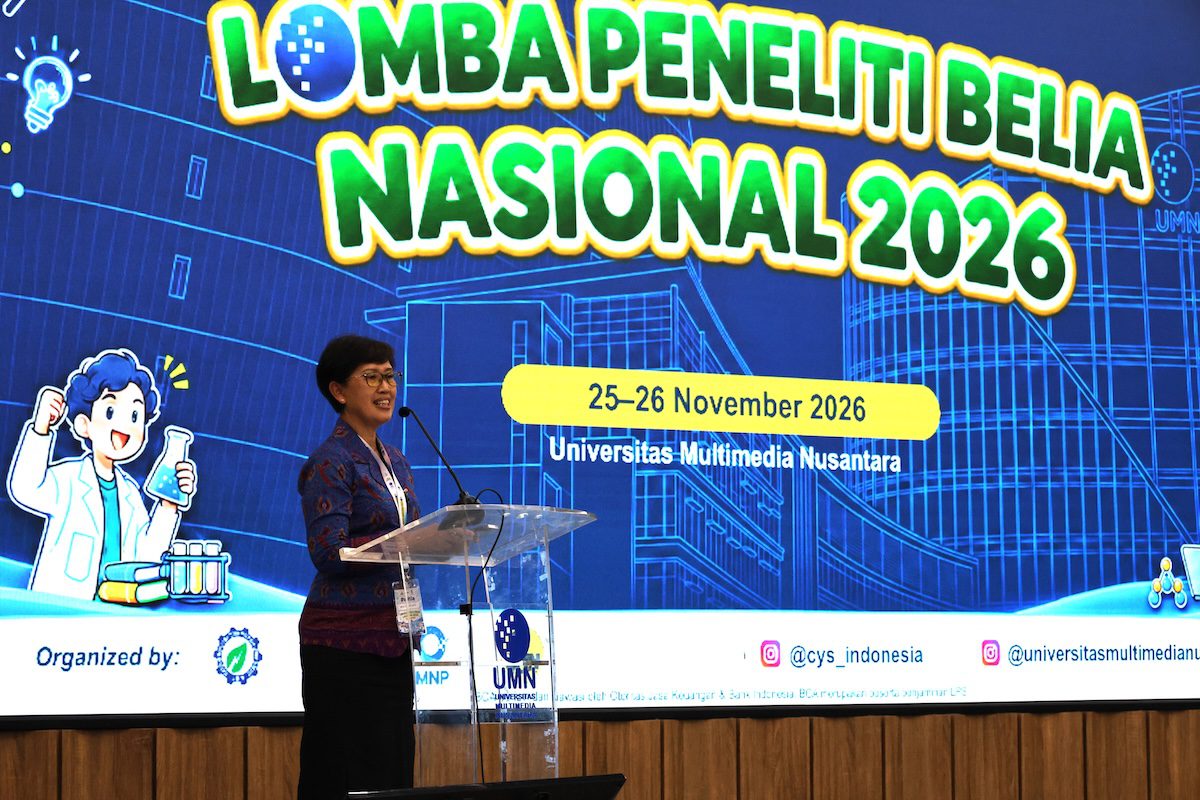
Deputy Minister of Higher Education, Science, and Technology, Stella Christie, during the opening ceremony and presentation at the 2026 National LPB (Photo: UMN CorCom)
The opening of the 2026 National LPB was also graced by the presence and support of Prof. Stella Christie, A.B., Ph.D., Deputy Minister of Higher Education, Science, and Technology of the Republic of Indonesia. On this occasion, Stella delivered a presentation titled “Innovation: AI vs. Humans.”
“As we know, artificial intelligence (AI) is everywhere today. This poses a challenge, especially for researchers. One recent example is OpenAI, which successfully solved ‘The Navier-Stokes Millennium Prize Problem.’ One of the seven mathematical problems that had posed a challenge for a millennium was successfully solved by AI. However, at the same time, there was a human researcher who was close to solving the same problem,” explained Stella.
Through this case, Stella questioned the role of scientists amid the development of AI. In her view, scientists are not merely individuals preoccupied with theories and numbers, but also figures who care about social issues, civilization, and the community. Scientists also need to build broad networks and engage with diverse groups, not limited to fellow scientists. This is because research aims not only to generate knowledge but also to make an impact on the world.
Presentation on “Innovation: AI vs. Humans” by Stella (Doc. CorCom UMN)
“Will research be replaced by AI within the next 10 years? Certainly not, as long as we possess the ability to think critically and analytically, to question things that didn’t exist before, and to be competitive,” added Stella.
For Stella, competition is often viewed as a taboo in Indonesia. Yet, in her view, being competitive is one of the essential traits a researcher must possess. She noted that although Indonesia has many intelligent and promising human resources, the country’s lag in science and technology remains a challenge that must be addressed.
“I also want to emphasize that as researchers, we shouldn’t be afraid to try new things or make mistakes. It is precisely through those mistakes that we can make new discoveries. In research, we conduct experiments to test and prove whether the hypotheses we propose are correct or incorrect. Sometimes, the results do show that our hypotheses are wrong, and that is actually the most important part of the research process,” she asserted.
Stella also explained that this process is one of the advantages humans have over AI. In research, documented mistakes and failures can serve as the foundation for new ideas. When researchers discover something previously unknown, it opens up opportunities to understand issues more deeply. It is this process of documenting and learning from mistakes that plays a crucial role in the advancement of science.
“In my opinion, the research we produce yields not only definitions or theorems but also deep understanding—including what is right, not just what is wrong. Will LPB still exist? I’m confident it will, as long as all of you understand and grasp the purpose of our research,” Stella concluded.
By Rachel Tiffany | UMN News Service
English translation by Levina Chrestella Theodora
Kuliah di Jakarta untuk jurusan program studi Informatika| Sistem Informasi | Teknik Komputer | Teknik Elektro | Teknik Fisika | Akuntansi | Manajemen| Komunikasi Strategis | Jurnalistik | Desain Komunikasi Visual | Film dan Animasi | Arsitektur | D3 Perhotelan , di Universitas Multimedia Nusantara. www.umn.ac.id