UMN Supports Sustainable Water Extraction Technologies Off Campus
December 13, 2025UMN Initiates and Participates in Cross-Sectoral Dialogues to Advance the Sustainable Development Goals
December 12, 2025Universitas Multimedia Nusantara (UMN) demonstrates its institutional commitment to meaningful education around the Sustainable Development Goals (SDGs) through a university-wide approach that integrates sustainability principles into its academic curriculum and learning activities. This commitment is formally established through the Sustainability Policy of Universitas Multimedia Nusantara, Rector’s Decree No. 1029/SK-R/XI/2025, which positions sustainability as a strategic principle governing the implementation of the Tri Dharma of Higher Education, institutional governance, campus operations, and external partnerships. 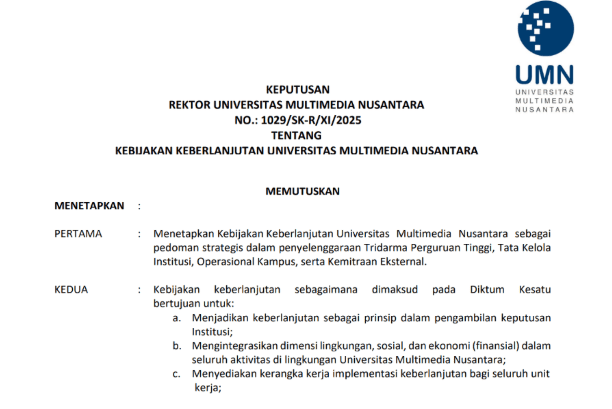
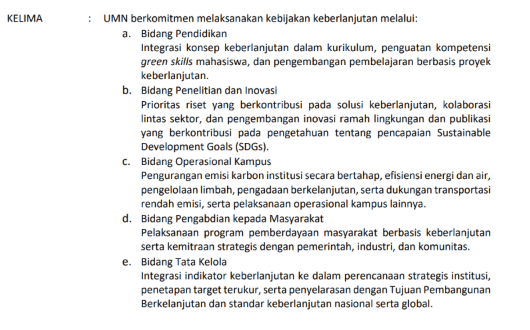
Under this policy, sustainability integration explicitly covers all university activities, including education and curriculum, research and innovation, community service, campus operations, partnerships, and institutional governance. In particular, the Education component mandates the integration of sustainability concepts into the curriculum, the strengthening of students’ green skills competencies, and the development of project-based sustainability learning.
The policy applies across all faculties and university work units, ensuring that sustainability education is embedded institutionally rather than being limited to specific academic disciplines. Each work unit is required to develop a sustainability action plan and periodically report its achievements, supported by annual monitoring and evaluation mechanisms.
This institutional commitment is reflected in UMN’s academic implementation. During the 2024/2025 academic year, UMN offered more than 170 courses focusing on sustainability and environmental topics across multiple faculties. These courses provide students from different study programs with opportunities to understand sustainability challenges and develop relevant competencies through their respective academic disciplines. 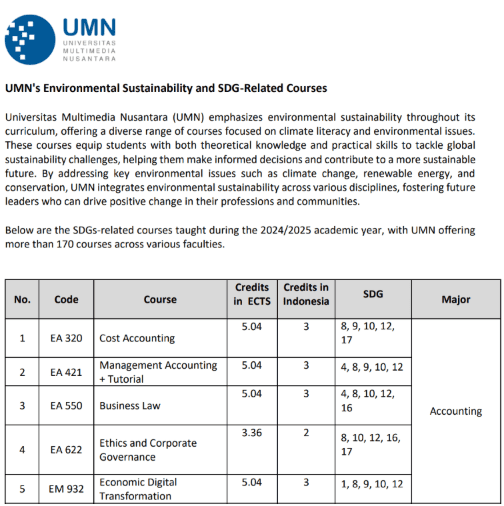
Beyond formal coursework, UMN also provides university-wide educational initiatives accessible to students regardless of their study programs. These initiatives aim to strengthen awareness, critical thinking, and active engagement with global challenges, including environmental sustainability, health, equality, digital ethics, and leadership.
Through its rector-approved sustainability policy, curriculum integration, and university-wide learning initiatives, UMN establishes sustainability education as an institutional commitment relevant to its entire student community.
One example is Architecture and Waste: Plastic, a course offered within UMN’s architecture education programme and documented in the academic paper Plasticity Imaginaries as Sustainable Design Pedagogy.
The course explores the potential of plastic waste as a sustainable architectural material, introducing students to sustainable design approaches, waste management, recycling, and the application of environmentally responsible practices in architecture and construction.
Its teaching approach combines theoretical discussions with practical workshops through a practice-based methodology. Students examine the opportunities and challenges associated with plastic waste, investigate material properties, and explore how sustainable design principles can be translated into everyday practices and professional decision-making.
The course demonstrates how sustainability education can move beyond theoretical understanding towards practical competencies and behavioural change. By connecting design pedagogy with real-world environmental challenges, students develop a deeper understanding of sustainability systems and their implications for architecture and the built environment.
Mandatory Sustainability Education for All Students 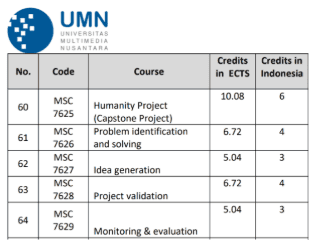
One of UMN’s key initiatives is the Humanity Project, a structured project-based learning programme equivalent to 20 academic credits (SKS), or approximately 33.6 ECTS. Applicable to all UMN students, the programme forms part of the university’s academic curriculum and graduation requirements. Through this programme, students engage directly with communities and develop projects that address social and environmental challenges.
The Humanity Project provides opportunities for students to apply sustainability principles through activities in 2025, such as:
- Mangrove planting: Supporting coastal ecosystem restoration and environmental protection.
- Environmental mitigation in Bayah: Engaging in initiatives that address local environmental challenges.
- Seagrass restoration: Contributing to marine biodiversity conservation and coastal ecosystem resilience.
- Spedagi Movement in Temanggung: Participating in the Nguri-uri Alam programme, which introduces eco-enzyme production from household organic waste as a community-based approach to sustainable waste management.
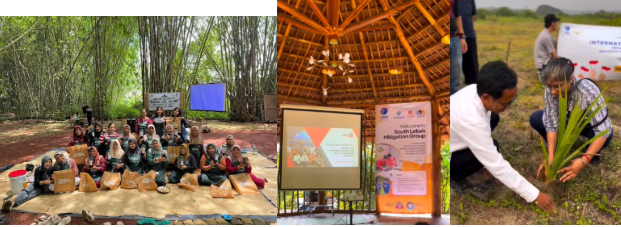
(Humanity project, 2025)
These activities allow students from different academic backgrounds to engage with sustainability issues beyond theoretical learning. By making the Humanity Project applicable to all students and recognizing it through academic credits, UMN embeds meaningful sustainability education within the university-wide curriculum rather than limiting it to optional extracurricular activities.
Dedicated Courses Addressing Sustainability and the SDGs
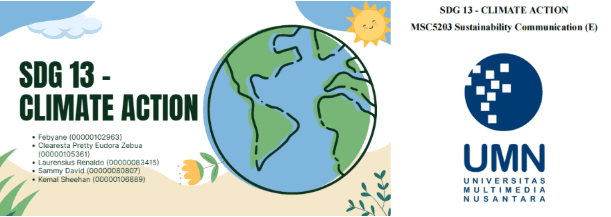
(Report of sustainability communication course, 2025)
In addition to the Humanity Project, UMN offers dedicated courses that address sustainability-related topics and their practical application.
One example is Sustainability Communication (MSC520), a credit-bearing course in which students develop communication strategies and media outputs to address sustainability issues. Through assignments such as environmental campaign videos, students learn to communicate sustainability messages, encourage responsible behaviour, and raise public awareness of environmental challenges.
The course combines academic concepts with practical communication outputs, allowing students to translate sustainability knowledge into campaigns designed for real audiences.
Project-Based Learning for Environmental and Community Impact
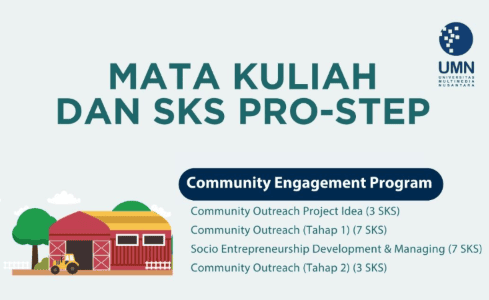
Sustainability education is also reflected in UMN’s Professional Step (Pro Step) initiative, which connects academic learning with community engagement through the university’s partner villages (desa binaan).
Through the Community Outreach Program, students contribute their knowledge and skills to support local micro, small, and medium enterprises (MSMEs), including assistance with product packaging, marketing strategies, business management, and digital promotion. These activities strengthen local business capacity while introducing students to sustainable community development.
During the 2024/2025 academic year, students completed 22 project-based learning outputs under the Pro Step programme, each equivalent to 20 academic credits. The projects addressed topics including disaster mitigation, community-based environmental resilience, sustainable local resource utilisation, and digital technology for environmental analysis. Examples included community education on disaster preparedness, local resource initiatives such as Marimba and the Spedagi Movement, and technological solutions involving geospatial analysis, disaster data visualisation, and environmental risk monitoring systems.
Through these academic programmes, UMN provides students with opportunities to understand sustainability challenges, develop relevant competencies, and contribute to practical solutions. By integrating mandatory sustainability learning, dedicated courses, and project-based community engagement into its academic offerings, UMN strengthens the role of SDG education across the university.